// NATURE NEWS — SPAZIO & SCIENZA
Lsp2 links early-life diet to adult translation and lifespan in Drosophila
Nature
(2026) Cite this article
Nearly a century ago, restricting diet during early-life periods was suggested to extend lifespan in rats and in Daphnia1,2. The effect of juvenile diet on adult physiology and lifespan has subsequently been described in other model organisms, including fruit flies3,4,5 and mice6,7,8; however, its mechanism remains poorly understood. Here, using Drosophila as a model, we show that restricting protein intake during the larval stage (early-life protein restriction; ePR) promotes adult lifespan by reducing the levels of storage proteins. Using stable-isotope tracing, we show that dietary amino acids obtained in the larval stage are retained into early adulthood, and are incorporated into ribosomal proteins in particular. This is mediated by larval serum protein 2 (Lsp2), a major storage protein, the expression of which is durably downregulated by ePR in the early adult stage. Genetic silencing of Lsp2 phenocopies ePR, attenuating ribosomal-protein abundance and translational activity in early adulthood, and extending lifespan. Restricting specific amino acids that are especially enriched in these storage proteins, such as phenylalanine and tyrosine, is sufficient to decrease the levels of early-life Lsp2 and promote longevity. These findings identify Lsp2 as a molecular carrier of nutritional history across developmental transitions, linking juvenile nutritional status to adult translational capacity and lifespan. Our study uncovers a previously unrecognized mechanism of nutritional memory that links early-life diet to lifelong organismal health.
Dietary restriction is a robust intervention that delays ageing and extends lifespan across diverse species. Transient nutritional manipulations not only during adulthood but also during early life stages can have long-lasting effects on adult physiology and lifespan, which can be positive or negative depending on the context4,5,7,9,10. This phenomenon, often referred to as nutritional programming, has been observed across taxa11,12. Several hypotheses have been proposed to explain this programming, including irreversible changes in organ structure; epigenetic modifications; trade-offs between growth, reproduction and somatic maintenance; metabolic and endocrine homeostasis; or gut microbiota13,14,15,16,17.
Drosophila has emerged as a powerful model for dissecting the mechanisms that underlie the effects of early-life dietary restriction. Although some reports suggest that larval yeast restriction produces adults that are small but that have a normal lifespan18, other studies provide evidence of considerable lifespan extension, depending on sex and the adult environment4,5,19. At the molecular level, transcriptomic shifts in ribosomal and translational machinery19 or altered production of lipid autotoxins (cuticular hydrocarbons)5 have been observed in long-lived adults. But so far, the molecular entity that encodes, preserves and transmits early-life nutritional information across developmental transitions has not been identified.
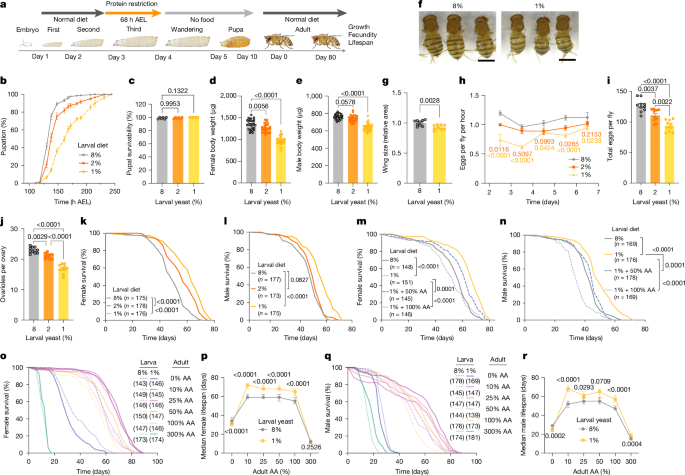
To establish an experimental set-up for elucidating the mechanisms of nutritional memory, we implemented dietary manipulation exclusively during the larval stage. Because yeast serves as the major dietary source of amino acids and protein for Drosophila under standard laboratory conditions, we manipulated yeast concentration during larval development to induce transient early-life protein restriction (ePR). Specifically, late-second-instar larvae were transferred to a low-yeast diet approximately 68 h after egg-laying (AEL). After eclosion, adult flies were returned to a standard yeast-based diet (Fig. 1a). We first assessed the effects of ePR on developmental timing, eclosion rate and systemic growth (Fig. 1b–e). Reducing the yeast content in the larval diet from 8% to 2% or 1% delayed development (Fig. 1b); however, once larvae reached the pupal stage, the eclosion rate was unaffected (Fig. 1c)