// NATURE NEWS — SPAZIO & SCIENZA
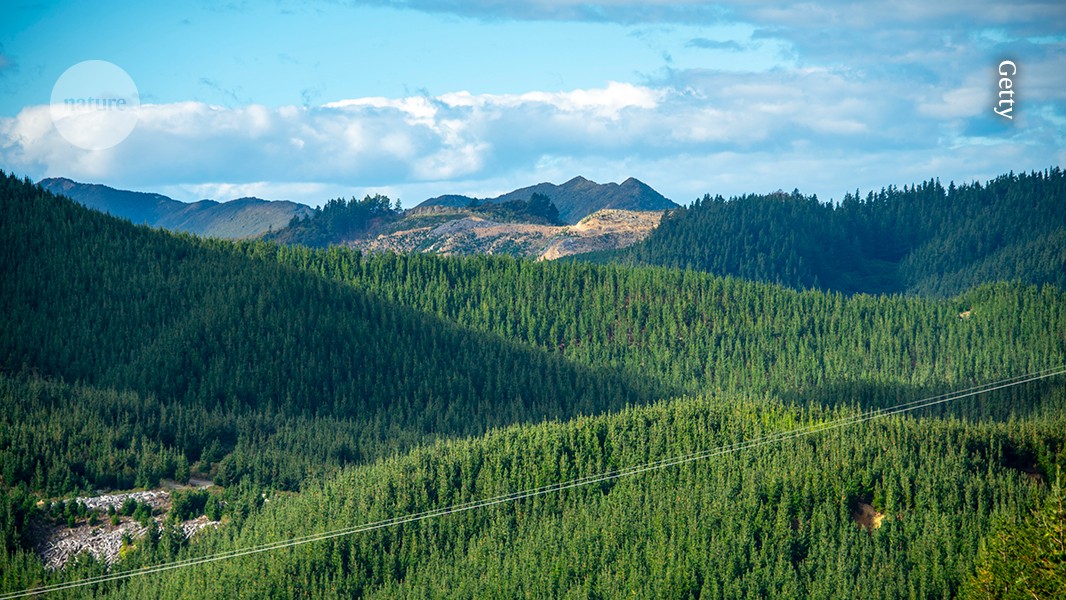
Conifer trees can prosper half a world away from their usual home
Steven A. Kannenberg is in the Department of Biology, West Virginia University, Morgantown, West Virginia 26506, USA.
Search author on:
PubMed
Google Scholar
Planting trees is often presented as a straightforward way to draw carbon dioxide from the atmosphere, but whether a planted forest remains a carbon sink depends on how well trees adapt to and endure in their home. Writing in Nature, Fajardo et al.1 report a striking result: Northern Hemisphere conifers that are introduced to the Southern Hemisphere can grow substantially faster than those in their original habitat. These non-native trees also resist and recover from drought more effectively than do those in the Northern Hemisphere. This finding challenges the expectation that rapid growth should come at the cost of stress tolerance and complicates the debate over which types of forest and which species should be promoted for climate mitigation.
Access Nature and 54 other Nature Portfolio journals
Get Nature+, our best-value online-access subscription
Prices may be subject to local taxes which are calculated during checkout
Blumstein, M., Sala, A., Weston, D. J., Holbrook, N. M. & Hopkins, R. N. Phytol. 235, 2211–2222 (2022).
Monson, R. K., Trowbridge, A. M., Lindroth, R. L. & Lerdau, M. T. N. Phytol. 233, 1051–1066 (2022).
Furze, M. E. et al. N. Phytol. 221, 1466–1477 (2018).
Seibt, U., Rajabi, A., Griffiths, H. & Berry, J. A. Oecologia 155, 441–454 (2008).