// TOM'S HARDWARE US — HARDWARE & GADGET
Synopsys debuts Autopilot platform for developing chips autonomously using AI
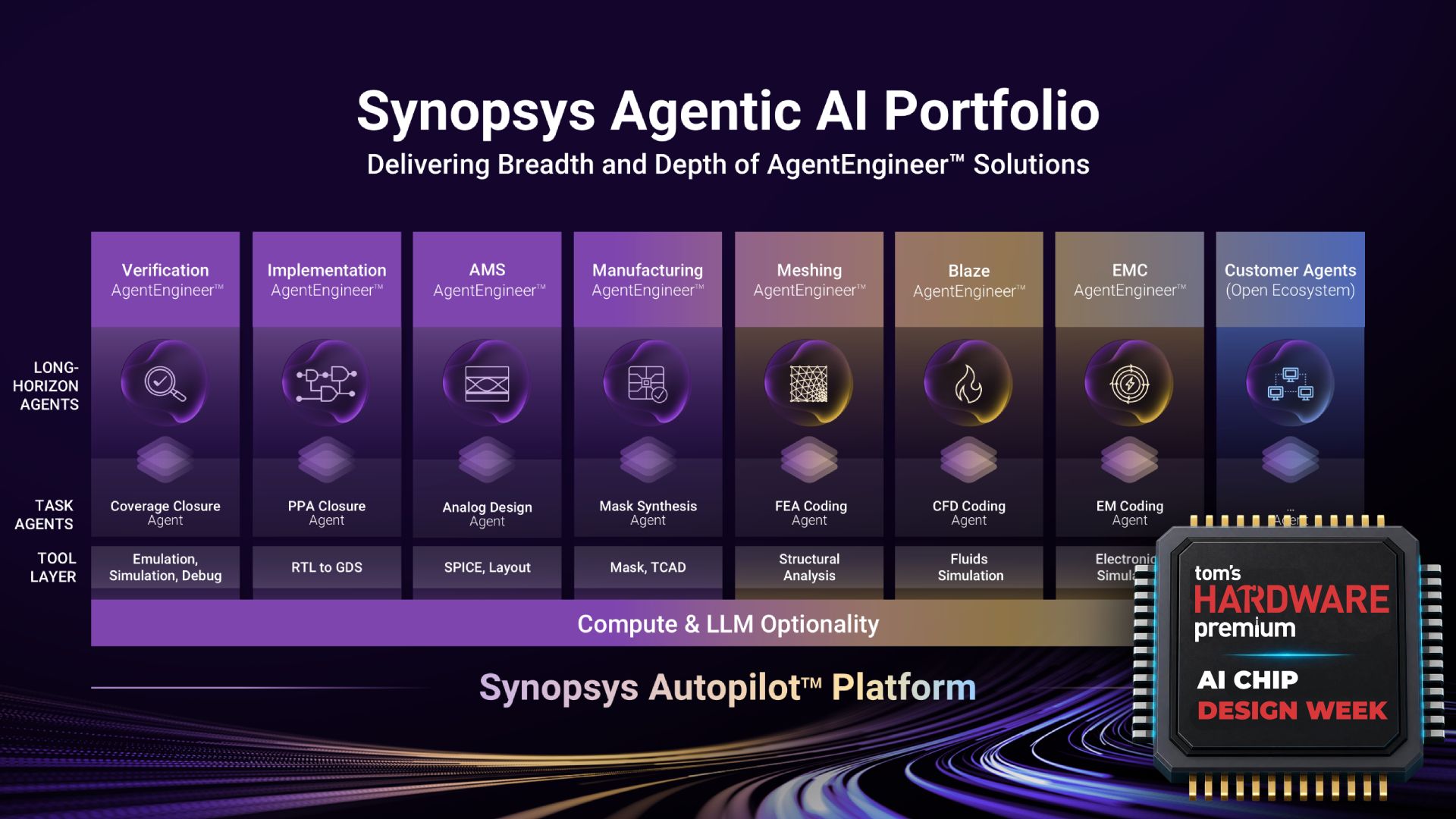
Seven specialized agents that work alongside customers' own models, data, and agents.
When you purchase through links on our site, we may earn an affiliate commission. Here’s how it works.
Synopsys announced its AgentEngineer solutions, a portfolio of “domain-specific long-horizon agents” built on its new Autopilot Platform. As the company details in a blog post, the portfolio covers six named domains: verification, system validation, implementation, analog and mixed-signal (AMS) design, manufacturing, and simulation and analysis. More than 50 customer engagements are underway, according to the company, and Synopsys confirmed to Tom’s Hardware Premium that general availability is planned for the end of 2026. This follows July, when the company showed agentic AI workflows developed with Nvidia and with Microsoft at DAC, the Design Automation Conference.
The launch brings Synopsys’ plans into focus with a named product line and a target date. The platform’s agents are clearly named and delineated, the engagement count points to customer interest, and a goal for general availability anchors a roadmap for autonomous agents in production. Two of the headline performance figures are restated from July, and the only named customer figure is one company’s range. While Synopsys describes the agents as autonomous, the approval checkpoints remain with humans, the company said.
For companies designing and producing chips who want to leverage the potential efficiency gains of AI, this technology allows them to “accelerate their shift from AI-assisted design to autonomous engineering,” said Ravi Subramanian, chief product management officer at Synopsys.
Floorplanning, placement, routing, congestion, DFT, and timing, power, and design-rule closure through signoff
Analog and mixed-signal design, layout synthesis, IP node migration, physical verification, and transistor-level timing and characterization
Process and device simulation, mask synthesis, and mask data preparation
Generating, validating, repairing, and optimizing simulation meshes
Gas turbine combustion studies and their simulation workflows