// NATURE NEWS — SPAZIO & SCIENZA
Pipework problems when cancer spreads to an area bordering the brain
Jang Hyun Park is at the Brain Immunology and Glia Center, Washington University in St. Louis, St. Louis, Missouri 63110, USA, and in the Department of Pathology and Immunology, School of Medicine, Washington University in St. Louis.
Search author on:
PubMed
Google Scholar
Jonathan Kipnis is at the Brain Immunology and Glia Center, Washington University in St. Louis, St. Louis, Missouri 63110, USA, and in the Department of Pathology and Immunology, School of Medicine, Washington University in St. Louis.
Search author on:
PubMed
Google Scholar
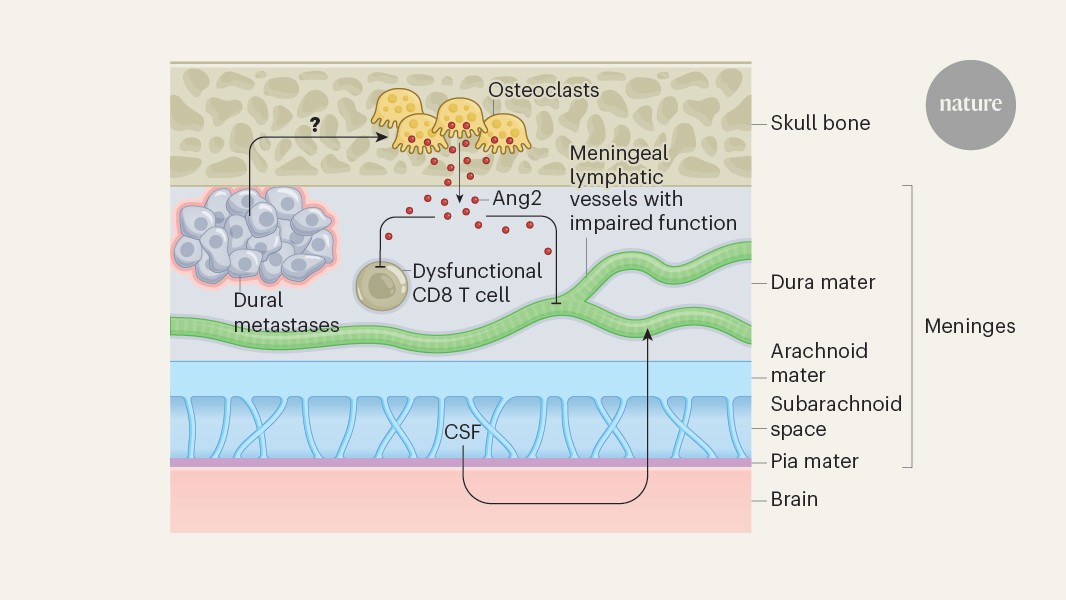
Tumours called dural metastases — those that spread to the outermost membrane surrounding the brain — do not just sit passively at the brain border. A picture is emerging of how extensively they restructure the surrounding area. Writing in Nature, Zeng et al.1 show that these tumours recruit cells called osteoclasts, which naturally degrade bone. Moreover, the osteoclasts disrupt fluid ‘pipes’ adjacent to the brain called meningeal lymphatic vessels and blunt local anti-tumour immune responses. This evidence reveals several possible targets in efforts to develop therapies.
Access Nature and 54 other Nature Portfolio journals
Get Nature+, our best-value online-access subscription
Prices may be subject to local taxes which are calculated during checkout
Zeng, R. et al. Nature https://doi.org/10.1038/s41586-026-11082-6 (2026).
Smyth, L. C. D. & Kipnis, J. Nature Rev. Immunol. 25, 766–775 (2025).