// NATURE NEWS — SPAZIO & SCIENZA
Dynamic protrusions mediate crawling motility in Asgard archaea
Nature
(2026) Cite this article
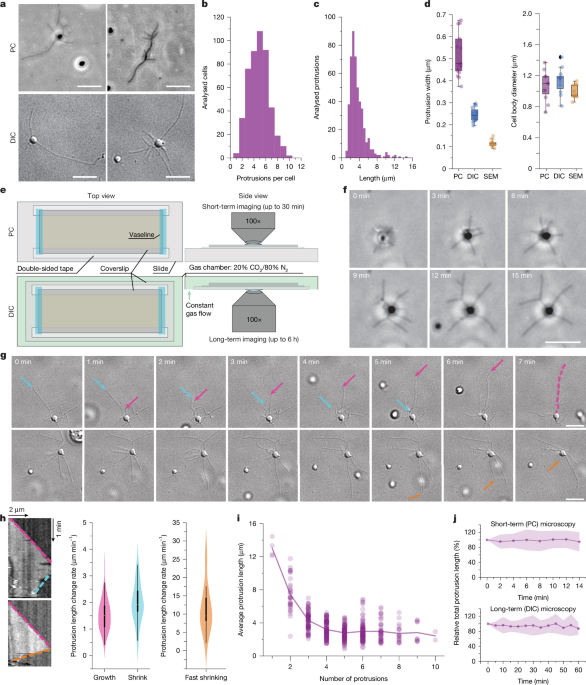
Crawling motility is a hallmark of eukaryotic cells and requires a dynamic actin cytoskeleton, regulated adhesion and spatially organized signalling pathways1,2. Asgard archaea, which are considered the closest known prokaryotic relatives of eukaryotes, potentially encode these functions within their large set of ‘eukaryotic signature proteins’3,4,5,6. The few cultivated members show a complex cell morphology, consisting of a central cell body from which several protrusions extend, filled with an actin-based cytoskeleton7,8. Here, live-cell microscopy of two organisms of the Lokiarchaea and Hodarchaea lineages7,9 showed that they dynamically and greatly change their cell shape on a minute time scale and grow and retract their extensive protrusions with a speed of 1.5–4.8 µm min−1, respectively. After adhering to a glass surface, cells use their protrusions to undergo active crawling motion. In the presence of selected actin inhibitors, however, the observed dynamics were arrested, suggesting a central role of actin in these processes. The observed cellular plasticity and motility are unique features among prokaryotes and might have been crucial for the emergence of the first eukaryotic cells that are thought to have formed through the association of a member of the Asgard archaea and an α-proteobacterium, the ancestor of mitochondria.
Since their discovery a decade ago, Asgard archaea (now formally classified as the phylum Promethearchaeota or Asgardarchaeota5,8) have inspired new models for eukaryogenesis10,11,12,13,14. Their genomes encode numerous so-called eukaryotic signature proteins (ESPs), including, for example, ESCRT and ubiquitination machineries, an actin-based cytoskeleton and associated proteins, as well as many small GTPases that were never found to this extent in other prokaryotes3,5,15. A recent structure-based analysis showed another plethora of ESPs in metagenome-assembled genomes16. Members of Promethearchaeota are now regarded as the closest prokaryotic relatives of eukaryotes and possibly as their direct ancestors about 2 billion years ago (refs. 6,9,17). Although current models of eukaryogenesis differ in their mechanistic details, most of them agree that eukaryotes emerged from a symbiosis or merger between an archaeon of the Promethearchaeota lineage and at least one α-Proteobacterium (or related), which evolved into mitochondria13,18,19. The few so-far cultivated cells of the Asgard archaea7,9,10,20,21,22 have shown a distinctive cell morphology: a central cell body from which protrusions of varying number and length extend. Furthermore, the outer membrane was not covered by a cell wall but found to be decorated with proteins, potentially used for establishing cell–cell contacts or formation of cell–substrate adhesions. The cell bodies and protrusions are filled with a cytoskeleton formed by the conserved actin homologue of Asgard archaea, referred to as Lokiactin, which is one of the most highly expressed proteins in Candidatus Lokiarchaeum ossiferum (L. ossiferum)7 and is, based on its sequence, closely related to eukaryotic actins7,23,24. Biochemical studies have demonstrated that profilin and gelsolins from Asgard archaea can bind and modulate eukaryotic actin, further demonstrating the close functional and evolutionary relationship of these proteins25,26,27. By analogy to eukaryotic pseudopodia, dynamic regulation of Lokiactin filaments could enable protrusion growth and retraction, thereby contributing to morphological plasticity and motility. To directly study if these processes occur in Asgard archaea, we established anaerobic live-cell imaging and demonstrated that both L. ossiferum and Ca. Margulisarchaeum peptidophilum (M. peptidophilum) undergo striking morphological rearrangements within minutes. Furthermore, both Asgard archaea strains exhibit crawling motility that involves extensive dynamics of their protrusions and is sens