// NATURE NEWS — SPAZIO & SCIENZA
Written in development and lost in ageing: the grammar of cellular identity
Nature
volume 658, pages 45–54 (2026) Cite this article
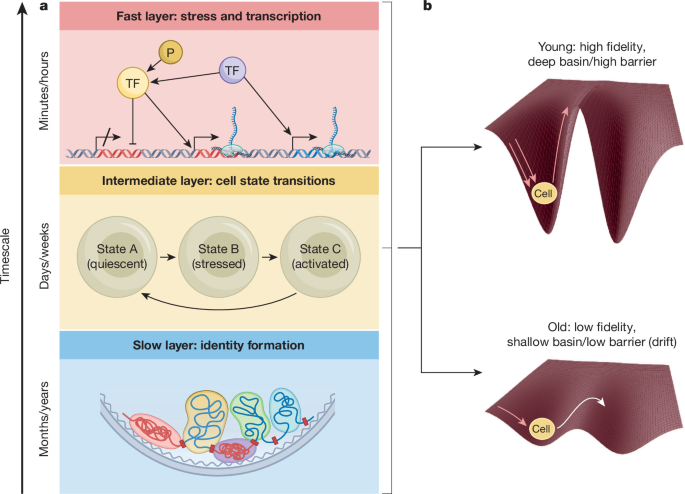
Ageing has been described through many theoretical frameworks, yet its mechanistic basis remains unresolved. Here we propose that ageing reflects progressive decanalization of mammalian cell identity, driven by erosion of a regulatory grammar written during development. Extending Waddington’s epigenetic landscape, development canalizes cell fates through globally coordinated chromatin programs that establish identity constraints across multiple timescales. Subsequently, these constraints can only be maintained through local mechanisms with limited fidelity. The asymmetry between high-fidelity writing and imperfect maintenance generates predictable drift that accumulates with biological time. Antagonistic chromatin pathways, particularly polycomb repressive complex 2 (PRC2)-mediated repression opposed by H3K4/36 methylation and RNA polymerase II binding, enforce identity boundaries through mutual constraint. With age, this balance erodes. Consistent with this framework, the vast majority of age-associated DNA methylation gain in somatic mitotic tissues occurs at PRC2-bound low-methylated regions, indicating that these domains function as conserved coordinates of slow-layer drift. This model explains cross-tissue ageing signatures, developmental timing-to-lifespan correlations and robustness of pan-mammalian epigenetic ageing clocks. It provides testable predictions for interventions that stabilize architecture to preserve cellular identity and function.
This is a preview of subscription content, access via your institution
Access Nature and 54 other Nature Portfolio journals
Get Nature+, our best-value online-access subscription
Prices may be subject to local taxes which are calculated during checkout
Sender, R. & Milo, R. The distribution of cellular turnover in the human body. Nat. Med. 27, 45–48 (2021).
Article
PubMed
Google Scholar
Spalding, K. L., Bhardwaj, R. D., Buchholz, B. A., Druid, H. & Frisén, J. Retrospective birth dating of cells in humans. Cell 122, 133–143 (2005).
Article
ADS
PubMed
Google Scholar