// NATURE NEWS — SPAZIO & SCIENZA
Function-preserving watermarking of AI-generated proteins
Nature
(2026) Cite this article
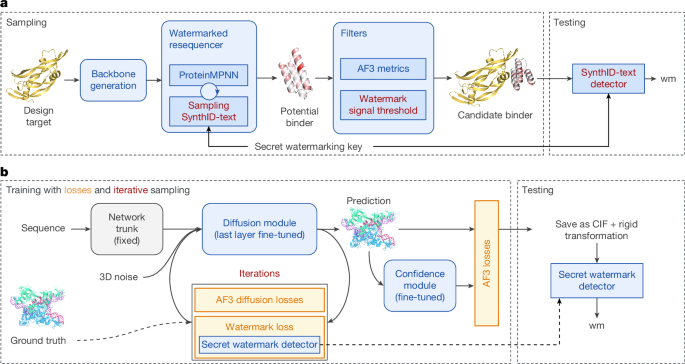
Generative artificial intelligence (AI) models are revolutionizing biology, with tools such as AlphaFold 3 and protein design models accelerating breakthroughs in protein structure prediction and the creation of new functional proteins1. Tracking and establishing the provenance of AI-generated protein sequences and structures is becoming increasingly important to tackle a range of emerging challenges, including biosecurity and concerns about information veracity2,3,4. Here we introduce SynthIDBio, a family of methods for watermarking protein sequences and structures to establish the provenance of those generated with AI. SynthIDBio-sequence actively embeds a watermark into protein sequences while preserving function. We demonstrate this by creating watermarked, functional designed protein binders with binding affinity comparable with non-watermarked counterparts and near-perfect watermark detection accuracy. Furthermore, SynthIDBio-structure, a fine-tuned AlphaFold3 model, embeds an imperceptible watermark into biomolecular structures. Our work is a proof-of-concept that function-preserving biological watermarking is feasible, introducing a potential tool for provenance in the rapidly expanding era of AI-driven biological engineering.
AI is accelerating biological discovery and design, with wide-ranging applications in therapeutics, diagnostics and biomedical research5. Specialist models for protein design and structural predictions are becoming an integral part of biological workflows. Ensuring their safe and responsible use involves the ability to determine and track the original model of AI-generated sequences and structures. This holds promise to address potential challenges that stem from the widespread adoption of ever more powerful AI models in biology, including biosecurity and information veracity. Here, information on provenance may become a useful signal for DNA synthesis providers2,4,6,7,8 and institutions managing biological databases such as the Protein Data Bank (PDB)9, UniProt10 or GenBank11.
Several means of establishing provenance for biological objects have been proposed, including through centralized databases or by associating metadata about the design process with the biological sequence2,12. Databases require central coordination, are prone to false positives at scale and may cause privacy challenges. Cryptographically signed metadata, by contrast, can preserve privacy, but is easy to remove. An alternative approach, watermarking, embeds signatures into the AI-generated objects themselves. This approach has successfully been applied to AI-generated text and multimedia and deployed in various products, including Google’s generative AI13,14. Watermarks promise high detectability and quality preservation by being imperceptible. They offer a privacy-preserving alternative where information on provenance is more challenging to remove and no central coordination is required. Moreover, watermarking can establish provenance for open model predictions. However, it is unclear whether existing watermarking methods transfer to biological modalities where preserving quality relates to the protein’s intended use: for protein design, this requires maintaining experimentally verifiable biological function; for structural prediction, it involves maintaining the accuracy of predicted structural features, ensuring a researcher’s interpretation and subsequent biological function hypotheses remain unchanged. Concurrent work for watermarking protein sequences is limited to in silico experiments with wild-type monomer structures from PDB3. Current methods result in a noticeable decrease in accuracy15 when watermarking protein structures. Combined, these show that function-preserving watermarking is not yet available.
We introduce SynthIDBio, a family of methods for embedding highly detectable yet function-preserving watermarks directly into biological sequences a