// NATURE NEWS — SPAZIO & SCIENZA
Semiconductors pushed into insulator territory
Hironori Okumura is at the Institute of Pure and Applied Sciences, University of Tsukuba, Ibaraki 305-8573, Japan.
Search author on:
PubMed
Google Scholar
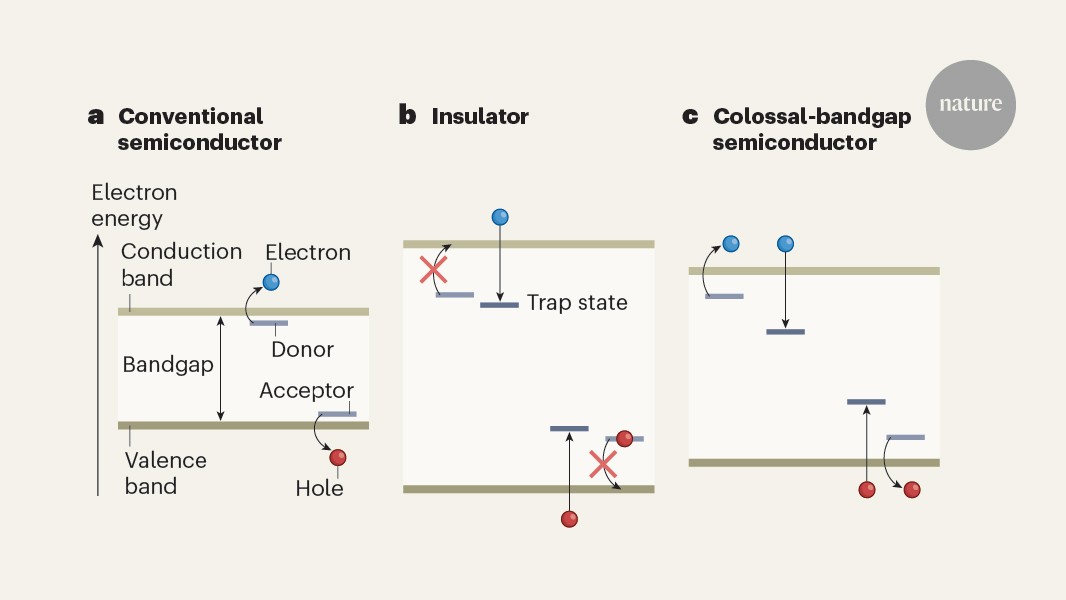
Semiconductors are materials that have an electrical conductivity between that of a conductor and an insulator. They are ubiquitous in modern technology, enabling the controlled flow of electricity in everything from solar cells to smartphones. The properties of a semiconductor are governed, in part, by its electronic bandgap — the energy needed to promote an electron to a conducting state. Semiconductors with large bandgaps are sought for electronic devices that must operate at high voltages or high temperatures, but such materials have been difficult to produce. Writing in Nature, Steele et al.1 report a semiconductor with the biggest bandgap recorded so far, which exceeds 7 electronvolts (eV). This demonstration pushes semiconductors into a regime that has long been reserved for insulators.
Access Nature and 54 other Nature Portfolio journals
Get Nature+, our best-value online-access subscription
Prices may be subject to local taxes which are calculated during checkout
Steele, J. et al. Nature https://doi.org/10.1038/s41586-026-11085-3 (2026).
Fujita, S., Oda, M., Kaneko, K. & Hitora, T. Jpn. J. Appl. Phys. 55, 1202A3 (2016).
Article
PubMed
Google Scholar
Okumura, H. & Varley, J. B. Jpn. J. Appl. Phys. 63, 075502 (2024).