// NATURE NEWS — SPAZIO & SCIENZA
Experimental observation of critical topology
Nature
volume 658, pages 365–371 (2026) Cite this article
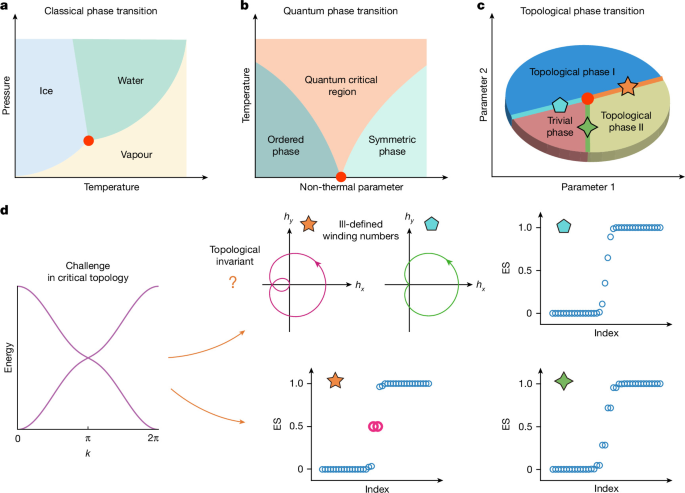
Understanding phases of matter and their transitions stands as a central pursuit in physical sciences, representing a continuously evolving frontier that drives fundamental discovery. Conventional phase transitions are marked by continuous order-parameter evolution and universal critical behaviour, whereas topological phase transitions are defined by abrupt changes of quantized topological invariants—two frameworks long viewed as distinct and even incompatible1,2. Recent theories have predicted quantum criticality endowed with nontrivial topology mostly in one-dimensional (1D) systems3,4,5, pointing to a potential unification of the two patterns. Yet experimental observation of such critical topology, that is, topology at phase boundaries and its extension to higher dimensions, remain outstanding. Here we report experimental evidence indicating that critical gapless topological states can be characterized by the entanglement spectrum (ES) and entanglement wavefunctions in both one and two dimensions, complemented by direct imaging of the topological boundary modes in gapless bulk continuum using engineered phononic crystals. Although implemented in a classical platform, our experimental approach gives results equivalent to those in the quantum limit and is in fact readily extensible to quantum systems. Through entanglement-based analysis, we illustrate that transitions among phase boundaries with distinct critical topology lead to multi-critical points in the phase diagram, evidencing topology-driven multi-criticality and a hierarchical structure of topological phases. Our work demonstrates a fundamental connection between topology and criticality, paving the way for an experimental route towards exploring topological physics at phase transitions.
This is a preview of subscription content, access via your institution
Access Nature and 54 other Nature Portfolio journals
Get Nature+, our best-value online-access subscription
Prices may be subject to local taxes which are calculated during checkout
The source data that support the findings of this study are available from the corresponding author on request. Source data are provided with this paper.
The code used to evaluate the conclusions of this study is available from the corresponding author on request.
Landau, L. D. & Lifshitz, E. M. Statistical Physics Vol. 5 (Elsevier, 2013).
Sachdev, S. Quantum phase transitions. Phys. World 12, 33 (1999).