// NATURE NEWS — SPAZIO & SCIENZA
A Jurassic mammaliaform swimmer and transformation of the mammalian pharynx
Nature
(2026) Cite this article
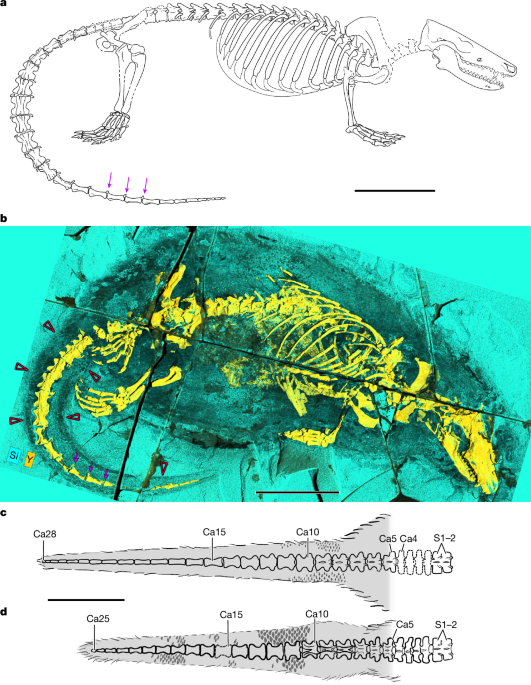
The discovery of a well-preserved mammaliaform fossil from the Middle Jurassic period of China reveals evidence on the evolutionary transformation of the feeding apparatus and the ecological diversity of Mesozoic era mammals. Mammaliaforms are evolutionary predecessors to modern Mammalia1,2,3, and their morphologies provide primary insights into the evolutionary origin of mammals. The rare preservation of a therian-like pharyngeal vault (throat passage) and hyoid skeletal anatomy (throat bones) in this mammaliaform suggests that critical soft-tissue anatomy for therian-like swallowing, drinking and suckling behaviours had evolved in the common ancestors of Docodonta and Mammalia, long before the rise of modern mammals. This fossil exhibits a wealth of features specialized for swimming, filling in a major gap of anatomical knowledge of pelvis and hindlimb for early mammals. It is characterized by highly distinctive canines and pseudo-carnassial sectorial teeth for a faunivorous diet. We interpret that this mammaliaform was semiaquatic, swimming and foraging in water, with a lifestyle analogous to the extant platypus. This species is the largest of Jurassic mammaliaforms. It expands the body size range of docodontans, and adds to a growing body of evidence that multiple docodontans exploited diverse niches with semiaquatic and other ecomorphotypes. Docodontans are an early example of replicated evolution of the semiaquatic and other ecomorphotypes in the Mesozoic ecosystem dominated by dinosaurs, long before the diversification of extant mammals.
This is a preview of subscription content, access via your institution
Access Nature and 54 other Nature Portfolio journals
Get Nature+, our best-value online-access subscription
Prices may be subject to local taxes which are calculated during checkout
Life Science Identifiers by the Zoobank for Systematic Palaeontology are registered for the new family Megacaudidae (urn:lsid:zoobank.org:act:20A95F1F-F06A-49B3-8DD8-6701704AD5D5), for the new genus Megacauda (urn:lsid:zoobank.org:act:858D78B8-9973-4C95-8286-CA05B77EFBBC) and for new species M. sungei (urn:lsid:zoobank.org:act:E1D7A965-E547-4705-8696-E63F672564ED). The Holotype PMOL-AM00026A/B is curated by Paleontological Museum of Liaoning, Shenyang, China.
Phylogenetic character list, data matrix (in Nexus) are presented in the Supplementary Information, as are the maximum parsimony (PAUP) analysis logs and Bayesian (MrBayes) analysis logs. Branch support values from TNT are provided in the Supplementary Information.
Kielan-Jaworowska, Z., R. L. Cifelli, & Z.-X. Luo. Mammals from the Age of Dinosaurs: Origins, Evolution, and Structure (Columbia Univ. Press, 2004).
Luo, Z.-X. Transformation and diversification in the early mammalian evolution. Nature 450, 1011–1019 (2007).