// NATURE NEWS — SPAZIO & SCIENZA
NASA releases trove of Moon data from historic Artemis II flight
Search author on:
PubMed
Google Scholar
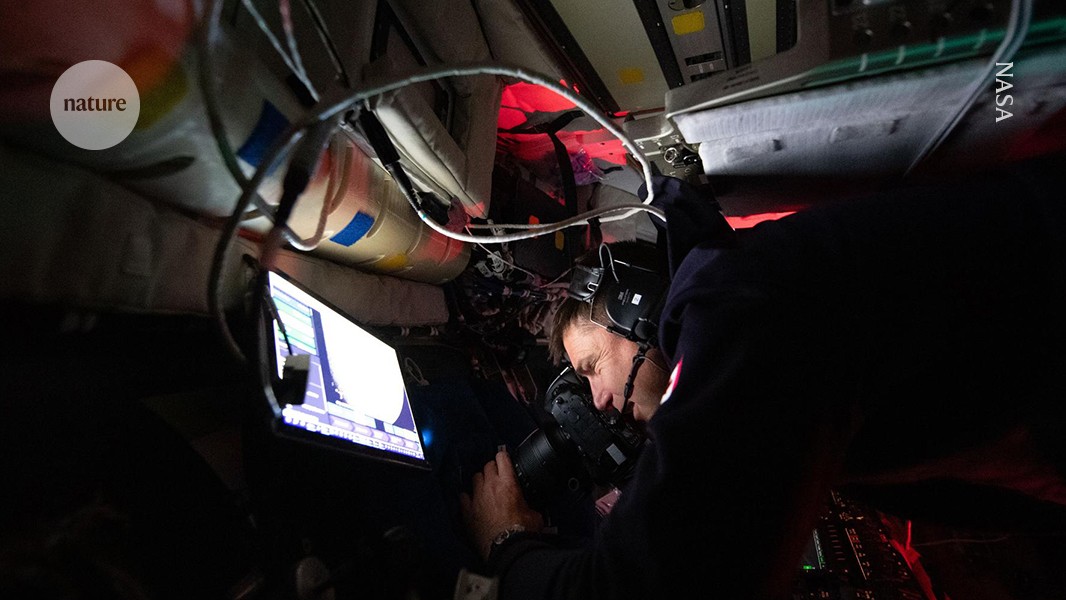
Artemis II astronaut Jeremy Hansen captures images during the lunar flyby.Credit: NASA
Planetary scientists have fresh Moon joy to explore. On 7 October, NASA released more than 800 gigabytes of images, audio recordings, written notes and other data gathered by the Artemis II astronauts on their historic flight past the Moon in April.
An accompanying report chronicles observations made by the first human eyes to view the Moon up close since 1972, such as the astronauts’ description of the colours of the lunar surface and the flashes of light seen by the crew as micrometeorites pelted the Moon.
But the report also details some of the challenges of sending humans to explore the surface of Moon, as both the United States and China plan to do. As lighting conditions changed, the Artemis II astronauts’ perceptions of the lunar surface also changed, showing how difficult it is to assess the Moon’s terrain accurately. At times, sunlight overwhelmed the crew’s vision. Understanding such issues is important for future astronauts trying to avoid hazards such as craters and boulders as they navigate onto and across the Moon.
Artemis II, which launched on 1 April and returned to Earth on 10 April, carried four astronauts around the Moon and back. The journey took the crew as much as 400,171 kilometres from Earth — the farthest that humans have ever travelled from their home planet. The goal was to test how well the mission’s Orion capsule could keep humans alive in deep space. But the astronauts also did some science, including more than six hours of lunar observation collectively dubbed “Moon joy”, during their 6 April flyby.
First photos from Artemis II: see stunning ‘Earthset’ and more
With today’s information release, “I’m really excited for the community to just take this and run,” says Marie Henderson, a planetary scientist at the University of Maryland Baltimore County in Baltimore, who is one of the mission's deputy lunar science leads. “A whole bunch of new eyes is just going to make a huge difference.”
The new lunar dataset adds to those gathered by multiple orbiters and flyby probes over the years, from many nations. Comparing and contrasting the Artemis II observations, made in-situ by human eyes, with those from robotic spacecraft can enrich understanding of the Moon, scientists say.
For instance, the astronauts’ descriptions of the colours of the lunar surface are valuable for providing a record of human perception, says Elisha Jhoti, a planetary scientist at the University of California, Los Angeles, who plans to work with the data. “The images we see from the Moon are not exact representations of what our eyes would see,” she says. The astronauts reported colours including brown, tan and green in various places on the Moon, including a shade like “mold growing on sandwich bread” in one spot, according to astronaut Christina Koch.