// NATURE NEWS — SPAZIO & SCIENZA
Competing mechanisms toughen bcc binary and medium-entropy alloys at 20 K
Nature
(2026) Cite this article
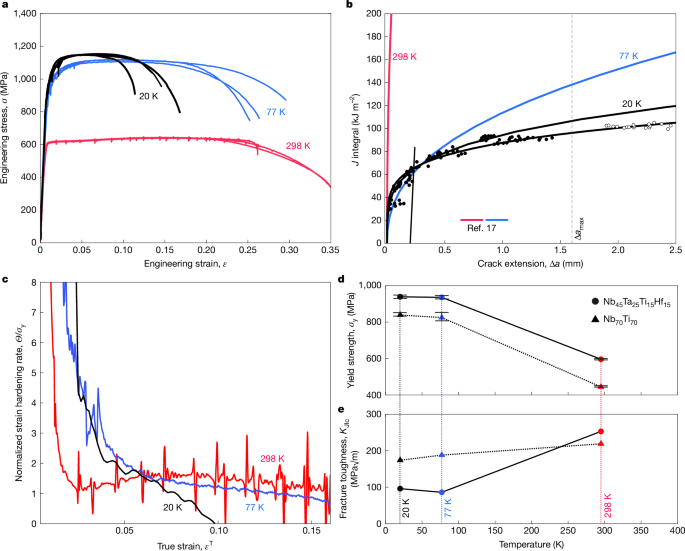
Plastic deformation in body-centred cubic (bcc) metals and alloys is conventionally mediated by screw dislocations. Their temperature-sensitive motion is attributed to a steep rise in strength with decreasing temperature that constricts plastic zones at crack tips, leading to a ductile-to-brittle transition1. Here we evaluated the mechanical properties of group IV–V bcc refractory alloys with similar electronic structures at 20 K and found that these materials instead exhibit a plateau in tensile yield strength and fracture toughness as a function of temperature, with no apparent ductile-to-brittle transition. This behaviour arises from the global activation of twinning and an ω-phase transformation, which nucleate dislocations at interfaces before global dislocation motion. The initial mechanism is temperature insensitive and controls yielding, thereby preventing a crack-tip plastic zone from constricting with decreasing temperature.
Alloys with the body-centred cubic (bcc) crystal structure have a ductile-to-brittle transition temperature (DBTT) below which plastic deformation is restricted, leading to embrittlement1,2. This problem has plagued bcc materials ranging from steels at or slightly below room temperature to refractory alloys up to 1,200 °C (refs. 3,4). The expansive set of current and potential applications for bcc alloys, such as refractory multi-principal alloys (commonly known as medium- or high-entropy alloys), for building and transportation infrastructure, energy technologies and hypersonic applications, is often limited by this transition5,6.
This limitation arises from their non-closed-packed crystal structure, which forces dislocations, specifically screws, to rely on thermally activated kink-pair nucleation to move2,7. Consequently, screw dislocation glide becomes sluggish at low temperatures, causing strength to increase precipitously and plasticity to be constricted at crack tips until fully brittle failure ensues8. Traditional strategies to suppress the DBTT primarily rely on facilitating screw dislocation glide through careful substitutional and interstitial alloying9,10,11,12: although interstitial elements increase DBTTs by introducing additional pinning stresses, substitutional alloying can, in some cases, ductilize bcc materials11. This has been observed in refractory binary and multi-principal element alloys, which are often extremely brittle4,11,13. Here concentrated additions of group IV (Ti, Zr, Hf) into group V (V, Nb, Ta) elements enhance screw dislocation glide, a phenomenon correlated with lowered unstable stacking-fault energies and increased kink-pair equilibrium concentrations11,14.
Beyond promoting dislocation glide, additional strategies for improving toughness involve activating multiple deformation mechanisms15. Twinning-induced plasticity (TWIP) and transformation-induced plasticity (TRIP) can elevate toughness by increasing strain hardening and uniform ductility15,16, while some softening mechanisms, such as kink banding, can also elevate toughness by promoting plasticity17,18. Although TWIP and TRIP mechanisms are highly effective at increasing cryogenic damage tolerance in face-centred cubic (fcc) alloys, their efficacy is limited in bcc alloys at low temperatures owing to fundamental differences in the mechanisms controlling nucleation, propagation and migration. This limitation arises from a competition between temperature-dependent dislocation glide stresses and more temperature-insensitive twinning stresses, which can converge at a slip-twinning transition19,20,21. Around this transition, it is hypothesized that the stress to transform 1/2<111> screw dislocation cores into three 1/6<111> fractional dislocations that bind a propagating twin embryo is lower than for the same dislocation to retain its compact core and glide22,23. This process can be accompanied by a phase transformation to the ω-phase, which can