// NATURE NEWS — SPAZIO & SCIENZA
De novo design of cysteine proteases
Nature
(2026) Cite this article
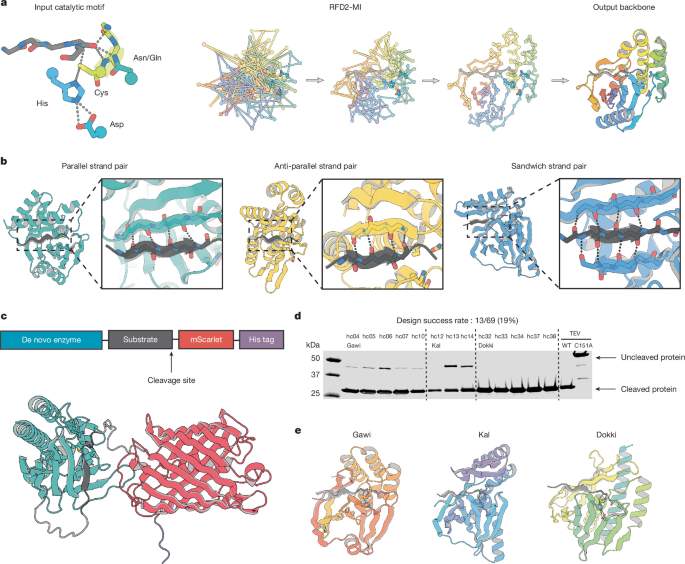
Despite advances in de novo enzyme design, success has been largely limited to low-energy-barrier model reactions. Amide bonds such as those linking amino acids along the peptide backbone are stable for hundreds of years in neutral aqueous solution because of the high energy barrier to hydrolysis1. Here we describe the de novo design of enzymes that use an activated cysteine nucleophile to hydrolyse the polypeptide backbone in a sequence-dependent manner, with a success rate of 13/69 = 19% and rate enhancements over the background reaction (kcat/kuncat) of up to 3 × 10⁷. The designed proteases have folds that are very different from proteases in nature (TM score < 0.50), and six crystal structures are very close to the design models (Cα root mean squared deviation of <1.2 Å), highlighting the capacity for generalization and the accuracy of the design methodology. Experimental and computational analyses suggest that the remaining gap in activity to the most active native cysteine proteases arises from imperfections in active-site preorganization and substrate positioning. The designed proteases efficiently cleave their targets in mammalian cells, opening the door to a wide range of synthetic biology applications.
This is a preview of subscription content, access via your institution
Access Nature and 54 other Nature Portfolio journals
Get Nature+, our best-value online-access subscription
Prices may be subject to local taxes which are calculated during checkout
Atomic coordinates and structure factors generated in this study are publicly available through the RCSB Protein Data Bank under accession codes 9YNL, 9YNM, 9YOX, 9YOY, 9YOZ and 9YP0. Source data underlying Figs. 1–5 and Extended Data Figs. 1–10 are provided with this paper. Publicly available structures used as computational inputs or structural references were obtained from the RCSB Protein Data Bank under accession codes 1EUV, 1TL9, 1ATK, 8A4V, 1NQC, 1ME3, 3BPF, 1BP4, 1CVZ and 1PPN. Protein sequences are provided in Supplementary Table 1, and complete plasmid DNA sequences are provided in Supplementary Information 1 and 2.
Code used for computational design and analysis is publicly available at GitHub (https://github.com/hojaec/RFD2_MI_cysteine_protease_pipeline). Code used for biochemical kinetic data and mammalian-cell images analysis is publicly available at GitHub (https://github.com/hojaec/Cysteine-protease-data-analysis).
Radzicka, A. & Wolfenden, R. Rates of uncatalyzed peptide bond hydrolysis in neutral solution and the transition state affinities of proteases. J. Am. Chem. Soc. 118, 6105–6109 (1996).
Article
ADS
CAS
Google Scholar