// NATURE NEWS — SPAZIO & SCIENZA
Daily briefing: China’s extraordinary rise in science
Search author on:
PubMed
Google Scholar
Hello Nature readers, would you like to get this Briefing in your inbox free every day? Sign up here.
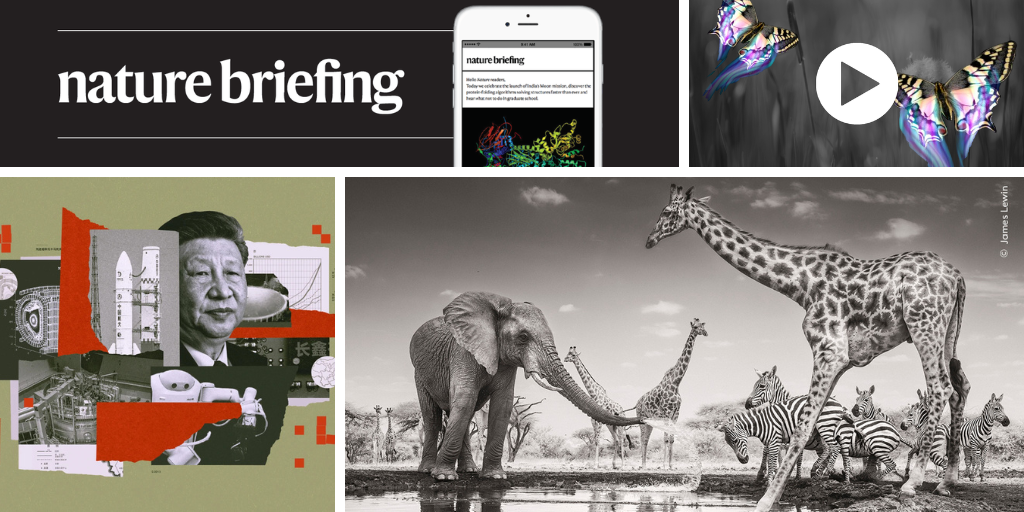
Illustration: Jasiek Krzysztofiak. Photos: Qilai Shen/Bloomberg/Getty; Shawn Thew/EPA/Bloomberg/Getty; AFP via Getty; Inst. Plasma Physics at Hefei Insts of Phys. Sci., Chinese Academy of Sciences; S. L. Chen et al./Sci. Rep. (CC BY 4.0); VCG via Getty(2)
In less than 50 years, China has gone from having almost no scientific presence on the global stage to a scientific powerhouse that is on course to lead the world in research and development. But before that happens, China will have to deal with some systemic concerns: a widespread scientific misconduct problem, questions about regulations and ethics in cutting-edge biomedical research and an academic culture that researchers say makes it hard for individuals to pursue long-term, curiosity-based projects.
Artificial-intelligence graduates in China are increasingly choosing to stay instead of pursuing opportunities abroad, a move that could help the country catch up to the United States in AI research. China-based researchers now dominate global AI-related publications, and the rise of firms such as DeepSeek and MoonshotAI has proven the capability of Chinese AI models. Competition for jobs is fierce and the pressure to publish is intense. But if China can retain its top talent, it’s possible that it could become the world leader in AI by the end of the decade.
After huge successes with GLP-1 obesity drugs, several pharmaceutical companies are turning their efforts to developing similar drugs to treat brain disorders. For example, pharma giant Eli Lilly has presented early clinical trial results of a compound related to tirzepatide for treatment of alcohol use disorder. And biotech company Kariya Pharmaceuticals has done the same for a GLP-1-like compound for Parkinson’s disease. But it’s not clear how exactly GLP-1 drugs might curb addiction, and past attempts to treat Parkinson’s with GLP-1 have failed.
Archaeologists say that amphorae and other artefacts discovered off the Mediterranean coast of Turkey are from the oldest shipwreck ever found. The team says that, on the basis of the pottery, the ship sailed during the Early Bronze Age, between 4,700 and 4,400 years ago. And the pots still had some goo inside. “I looked inside and nearly fainted,” says archaeologist Karin Sowada. “It could be olive oil, it could be wine, it could be tree resins.”
Reference: Journal of Maritime Archaeology paper & Journal of Maritime Archaeology paper
Photographer James Lewin used an infrared camera to render the harsh sunlight at a watering hole in Kenya into dreamy black and white. It won the ‘Animals in their Environment’ category of Wildlife Photographer of the Year, developed and produced by the Natural History Museum, London. (BBC | 10 min read) (James Lewin/Wildlife Photographer of the Year)
Birds that are moved, or bred in captivity, for conservation reasons might not have the chance to learn from their elders. But research suggests it is possible to teach birds lost songs. For example, in Argentina, researchers taught rufous-collared sparrows (Zonotrichia capensis) songs from hand-drawn annotations made in the 1960s. Someday, songs recorded by hobbyist birders could help restore lost aural diversity, says physicist Gabriel Mindlin, who co-authored the sparrow study. “One day we’ll be grateful to have all those records,” he says.