// SPACE.COM — SPAZIO & SCIENZA
Returning the first samples from a Martian moon: Inside the science of Japan's bold MMX mission to Mars
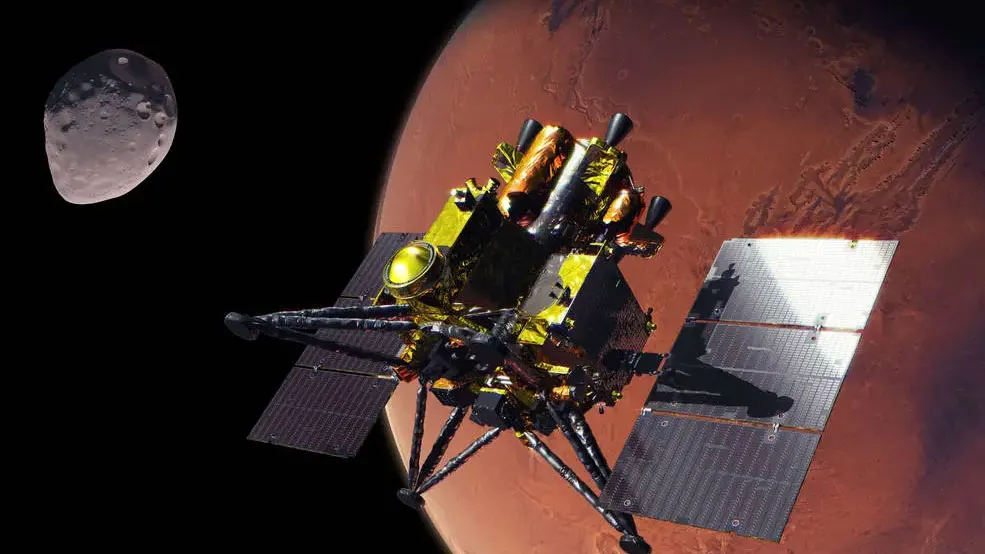
MMX could be the first spacecraft to ever return from orbit around the Red Planet.
When you purchase through links on our site, we may earn an affiliate commission. Here’s how it works.
Japan's mission to Mars is one of the most ambitious in spaceflight history. It aims to become the first spacecraft to return to Earth from Mars orbit, carrying with it the first-ever samples from the Red Planet system.
The mission, known as Martian Moons eXploration (MMX), is a first-of-its-kind endeavor to study the origin of Mars' moons Phobos and Deimos. The robust undertaking includes a landing on Phobos to collect the samples — which will likely be the first from the Mars system to return to Earth — and a search for evidence that could shed light on events during the formation of the solar system billions of years ago.
MMX is scheduled to launch on an H3 rocket from Japan's Tanegashima Space Center on Monday (Oct. 19) at 3:41 p.m. EDT (1941 GMT; 4:41 a.m. local time in Japan, Oct. 20). After a 10-month journey to reach Mars, the spacecraft will spend about three years studying Phobos, deploying a rover and landing to collect its samples. The mission will then shift its focus to Deimos for a series of flybys before departing for Earth in November 2030. If all goes according to plan, the MMX sample-return capsule is scheduled to land in Australia in 2031.
The MMX spacecraft is comprised of three main parts, as well as a small rover. After release from its H3 launch vehicle, a propulsion module will provide the boost to put MMX on course for Mars. MMX's main exploration module carries the microwave-size IDEFIX rover and most of the mission's scientific instruments, while the return module houses the sample-return capsule.
Japan's Mitsubishi Electric built MMX's three main modules, with the French space agency CNES (Centre National d'Études Spatiales) and Germany's DLR (Deutsches Zentrum für Luft-und Raumfahrt) jointly developing IDEFIX. The little rover is named for a dog in the 1960s French comic "Asterix," in a nod to the country's first satellite, Astérix, which launched in 1965.
IDEFIX carries a suite of cameras, as well as the Raman Spectrometer for MMX (RAX) and miniaturized radiometer (miniRAD) instruments to analyze Phobos' surface composition and temperature.
Most of MMX's scientific instruments are housed on the exploration module, like NASA's Mars-moon Exploration with Gamma rays and Neutrons (MEGANE, pronounced "meh-gah-nay") device, a gamma-ray and neutron spectrometer built by the Johns Hopkins Applied Physics Laboratory (APL), and France's MIRS (MMX InfraRed Spectrometer) instrument.
The exploration module also houses the Japanese-built TENGOO (TElescopic Nadir imager for GeOmOrphology) tight-zoom camera, wide-angle OROCHI (Optical RadiOmeter composed of CHromatic Imagers) multispectral camera, laser altimeter (LIDAR) and Mass Spectrum Analyzer (MSA). The return module, meanwhile, carries Japan's Circum-Martian Dust Monitor (CMDM) and Interplanetary Radiation Environment Monitor (IREM).