// NATURE NEWS — SPAZIO & SCIENZA
A single archaeon couples long-chain fatty acid oxidation to methanogenesis
Nature
(2026) Cite this article
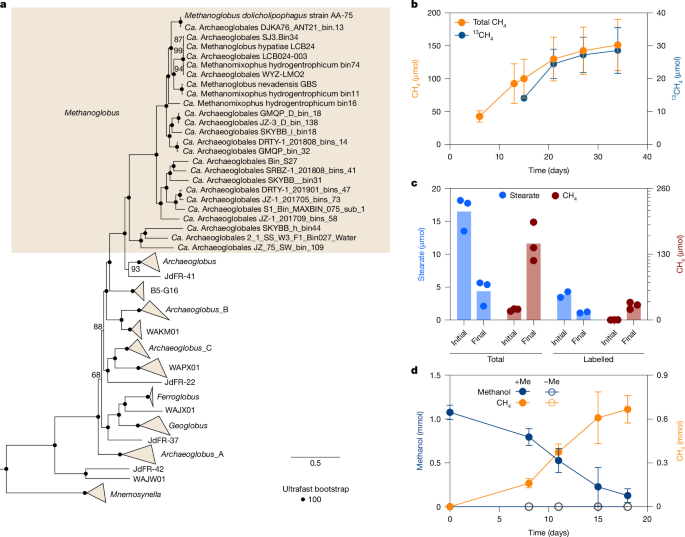
Anaerobic degradation of complex organic compounds to methane and carbon dioxide is common in the deep subsurface biosphere and has long been considered to require syntrophic cooperation, with methanogens confined to the terminal use of simple C1 and C2 substrates. Thermodynamic considerations, multi-omics analyses and microcosm experiments suggest that archaeal lineages are capable of methanogenic degradation of complex substrates1,2,3,4,5,6. However, experimental validation in pure culture was lacking. Here we report the isolation of a thermophilic archaeon, Methanoglobus dolicholipophagus AA-75, affiliated with Archaeoglobi, from a Chinese petroleum reservoir. Strain AA-75 not only converts methanol into methane, carbon dioxide and acetate, but also uses saturated fatty acids varying from C7:0 to C18:0 and unsaturated fatty acids including C16:1, C18:1 and C18:2 to produce methane. We term the latter lipotrophic methanogenesis, which integrates β-oxidation of fatty acids with the Wood–Ljungdahl pathway and the canonical methyl-tetrahydromethanopterin:coenzyme M methyltransferase and methyl-coenzyme M reductase complexes, together with an intracellular electron transfer system. A formaldehyde-methanol branch probably functions as an auxiliary route for C1 metabolism during methanogenesis. Methane produced from stearate is moderately 13C-enriched (δ13C–CH4 = −40.0‰ to −36.3‰), distinct from the strong 13C depletion characteristic of canonical methanogenic pathways. These findings demonstrate that methanogens can function as primary degraders of complex organic matter, challenging the classical syntrophic paradigm and calling for refinement of current models of carbon cycling in the deep subsurface biosphere.
This is a preview of subscription content, access via your institution
Access Nature and 54 other Nature Portfolio journals
Get Nature+, our best-value online-access subscription
Prices may be subject to local taxes which are calculated during checkout
The 16S rRNA gene amplicon sequences, genomic and transcriptome data generated in the current study are publicly available under BioProject accession number PRJNA1391892 in NCBI and BioProject accession number OEP00006789 (https://www.biosino.org/node/project/detail/OEP00006789) at the NODE database. Further details are provided in Supplementary Table 15. All other data are presented in the Article and its Supplementary Information. Source data are provided with this paper.
Helgeson, H. C., Owens, C. E., Knox, A. M. & Richard, L. Calculation of the standard molal thermodynamic properties of crystalline, liquid, and gas organic molecules at high temperatures and pressures. Geochim. Cosmochim. Acta 62, 985–1081 (1998).
Article
ADS
CAS
Google Scholar
Amend, J. P. & Shock, E. L. Energetics of overall metabolic reactions of thermophilic and hyperthermophilic archaea and bacteria. FEMS Microbiol. Rev. 25, 175–243 (2001).