// NATURE NEWS — SPAZIO & SCIENZA
An environmentally regulated dichotomy in cell lineages of the root
Nature
(2026) Cite this article
Plant development is highly plastic, with growth and architecture continuously shaped by environmental conditions. Roots, for instance, adjust their development to local water, nutrient and soil conditions. Despite this plasticity, individual root cell types are generally viewed as largely homogeneous populations that progress along a single developmental trajectory1. Here we show that rather than progressing along a single developmental trajectory, most Arabidopsis root cell lineage trajectories exhibit a stereotyped bifid topology, as revealed by single-cell RNA sequencing and spatial transcript mapping. One branch is characterized by a transcriptional program that is shared across multiple cell types and enriched for genes associated with environmental responses, including abscisic acid (ABA) signalling. This state occurs reproducibly in a subset of cells across multiple cell types, independent of developmental lineage, thereby revealing an additional layer of root cell identity. It is conserved across Arabidopsis ecotypes and persists despite major perturbations in developmental identity. Moreover, it is reduced in ABA-deficient and ABA-insensitive mutants and becomes more prevalent under water-deficit conditions. Together, these findings reveal an additional layer of root cell identity that is superimposed on developmental lineage and its prevalence is modulated by environmental conditions. These results uncover a previously unrecognized source of environment-associated transcriptional heterogeneity shared across root cell types.
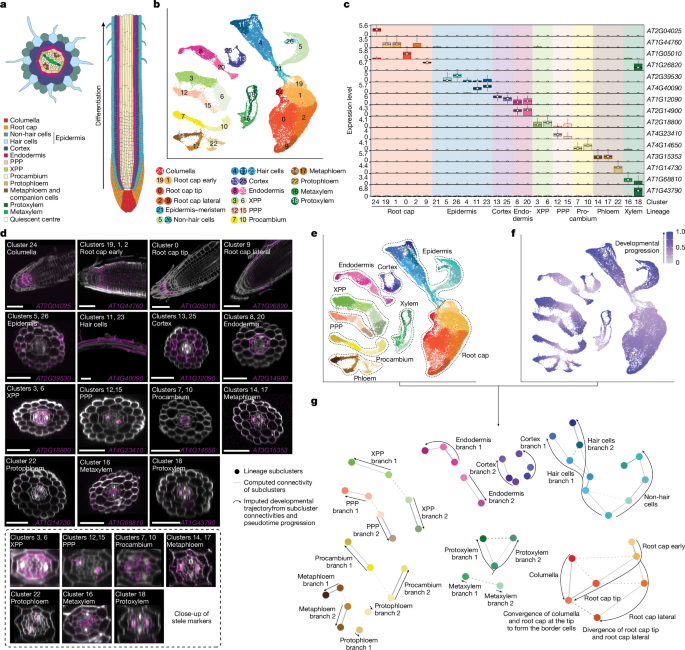
The root of Arabidopsis thaliana is a valuable model for studying cell differentiation in plants. Cell types are arranged in concentric layers around a central vascular bundle and arise from distinct stem cell populations maintained near the root tip in the meristem1. As stem cells divide, their descendants are displaced shootward and progressively differentiate, which creates developmental trajectories in which the spatial arrangement of cells recapitulates the temporal dynamics of differentiation (Fig. 1a).
a, Schematic representation of the root tip. b, UMAP plot of our reference atlas of 87,056 Arabidopsis Col-0 cells (9 samples). Cells are coloured by clusters, the identity of which was determined by whole-mount HCR. c, Box plots showing the cluster-specific expression of 15 markers used for determining cluster identity via whole-mount HCR (n = 87,056 cells from 9 independent experiments). Boxes show the median, 25–75th percentiles and whiskers extending to the most extreme values within 1.5× the interquartile range; white points indicate means. d, Top, whole-mount HCR of the 15 markers identified in c for precise cell-type assignment of the clusters. Bottom, close-up of stele markers is shown for clarity. Representative images are shown; results were reproduced in at least two independent experiments with similar results. Scale bars, 50 μm. e, UMAP plot of the reference atlas showing the different cell lineage subdivisions treated independently in the pseudotime analysis. Cells are coloured by subclusters in each lineage. f, UMAP plot showing the diffusion pseudotime assignment for each cell, per lineage. t = 0 corresponds to the cell with the highest meristematic score and t = 1 represents the most distinct state from t = 0 in the lineage. g, Developmental trajectories obtained by combining the connectivity between the subclusters shown in e computed in a PAGA and the pseudotime inference calculated in f reveal two distinct developmental branches affecting all cell lineages (named branch 1 and branch 2).
Single-cell RNA sequencing (scRNA-seq) has refined the transcriptional signatures of Arabidopsis root cell types and enabled high-resolution reconstruction of these developmental trajectories2,3,4,5,6,7,8,9. Although these studies have identified transient cell states in individual lineages, they have largely analysed each li