// NATURE NEWS — SPAZIO & SCIENZA
Enzyme-embedded polyesters for accelerated biodegradation in the deep sea
Nature
(2026) Cite this article
The accumulation of persistent plastics in the ocean is causing wide-ranging environmental problems1,2,3. Some commercially available compostable plastics4,5,6,7, developed to address these issues, degrade efficiently under industrial composting conditions; however, their degradation in marine environments, particularly in the deep sea, remains limited8,9,10. Here we demonstrate that thermally embedding enzymes into compostable polyesters (poly(butylene succinate) (PBS), poly(butylene succinate-co-adipate) (PBSA), poly(ε-caprolactone) (PCL) and poly(butylene adipate-co-terephthalate) (PBAT)) significantly accelerates their degradation in both coastal and deep-sea environments from water depths of 2–6 m to 5,503 m. Enzyme-embedded polyesters achieved near-complete degradation at a deep-sea depth of 757 m within 5 months. Furthermore, moderate biodegradation of enzyme-embedded polyesters was observed under extreme conditions on deep-sea floors of 5,503 m. In coastal seawater, films embedded with trace amounts (0.1 wt%) of enzyme underwent rapid degradation. The mechanical properties of enzyme-embedded polyesters were similar to those of enzyme-free polyesters. Chemical analysis confirmed the formation of low-molecular-mass degradation products and biochemical oxygen demand measurements supported the mineralization of the enzyme-embedded polyesters. The enzyme-embedding strategy enables enhanced marine degradation of compostable polyesters and represents a potential solution to marine plastic pollution.
Plastics are indispensable in many areas of modern life, but their accumulation in marine environments has emerged as a global environmental issue1,2,3. Biodegradable plastics have been considered a promising mitigation strategy4,5,6. Most commercially available biodegradable plastics are compostable4,5,7, meaning that their degradation is optimized for industrial composting conditions characterized by elevated temperatures, high microbial activity and humidity. However, some compostable polyesters have shown limited degradation and may therefore persist in these environments8,9,10. In marine environments, particularly in the deep sea, low temperatures and lack of viable microorganisms capable of degrading these plastics can substantially limit polyester degradation8,9,10,11,12,13, raising concerns about their environmental persistence.
Recent studies have demonstrated that embedding specialized enzymes directly into polymers can enhance their biodegradation14,15,16,17,18,19,20,21,22. However, these demonstrations have been confined to laboratory or closed-system incubations, and whether enzyme-embedded polyesters can achieve efficient degradation in situ under natural marine environments, particularly in the deep sea, remains unknown. At the same time, practical deployment requires enhanced biodegradability without compromising the mechanical properties needed for use.
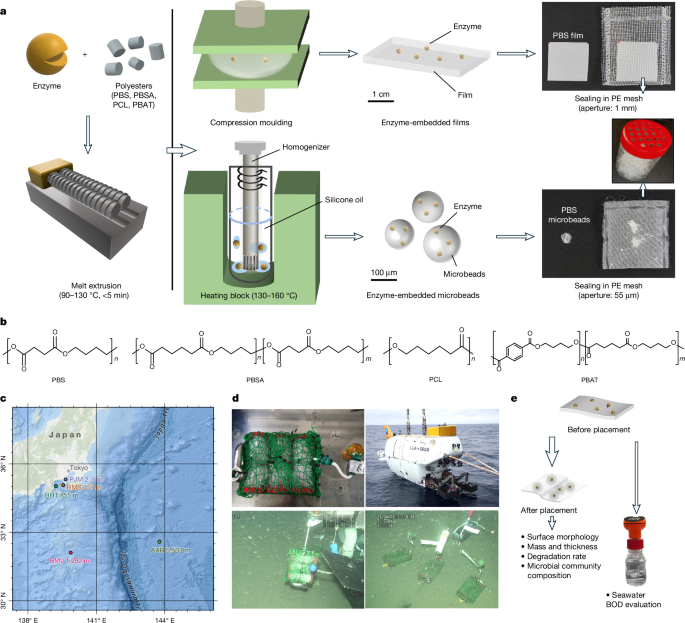
In this study, thermally embedding Candida antarctica lipase B (CaLB) or Humicola insolens cutinase (HiC) in various compostable polyester films and microbeads, including PBS, PBSA, PCL and PBAT, has been shown to significantly accelerate their degradation in coastal and deep-sea environments, ranging from water depths of 2–6 m to 5,503 m (Fig. 1 and Supplementary Table 1a–c). CaLB and HiC were selected for their broad hydrolytic activity towards aliphatic and aromatic–aliphatic polyesters23,24,25,26,27. Their high thermal stability in freeze-dried form enabled retention of catalytic activity during thermal embedding16,18,28.
a, Schematic illustration of the preparation of enzyme-embedded polyesters in film and microbead forms. Enzymes are embedded into polyesters (PBS, PBSA, PCL and PBAT) through melt extrusion at 90–130 °C for less than 5 min. The extrudate is then processed via two pathways: compression moulding to produce enzyme-embedded films, or homogenization in silicone oil to form enzyme-emb