// NATURE NEWS — SPAZIO & SCIENZA
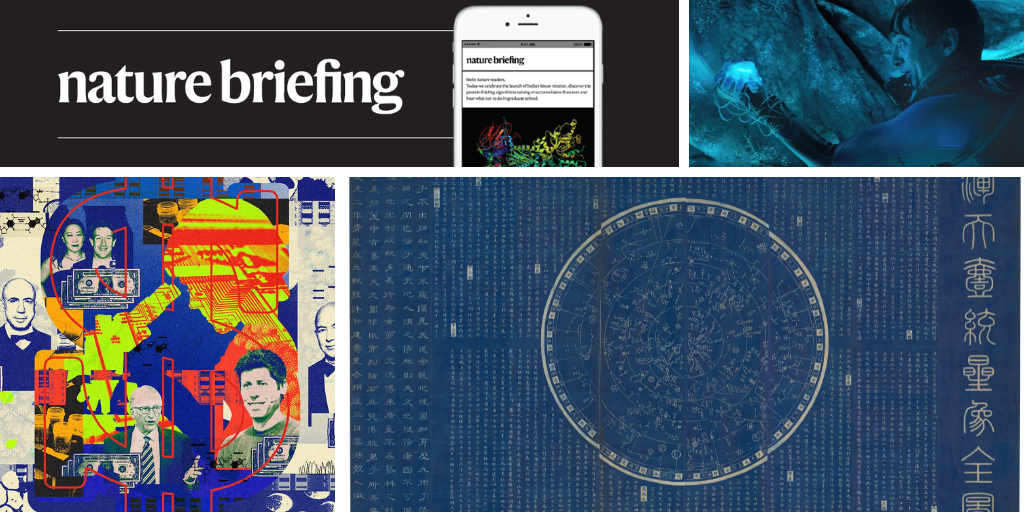
Daily briefing: How tech billionaires are changing science funding
Search author on:
PubMed
Google Scholar
Hello Nature readers, would you like to get this Briefing in your inbox free every day? Sign up here.
Illustration: Mr.Nelson design; adapted from Minh Connors/Bloomberg, Michael Kovac/Breakthrough Prize, Sean Gallup, Angela Weiss/AFP (all via Getty)
With some big AI companies soon to go public on the stock market, the ranks of ultra-rich philanthropists in the United States look set to grow. Compared to government funding agencies, ultra-wealthy research investors tend to support projects that are higher risk and more personally relevant, with fewer strings attached. But there’s less oversight of philanthropic programmes, it’s difficult to assess their success and many are geared towards encouraging the use of the same technology the philanthropists profited from developing.
This celestial map of 1822, closely modelled on an earlier stone stele from 1247, reflects the Taoist conception of the cosmos as a ‘Celestial Bureaucracy’ with the heavens divided into hierarchical offices and ranks resembling those on Earth. This huge coloured woodcut by Yunyou Sanren 雲遊散人 (Shang Huang 黃裳) is on display in Night Maps at the Warburg Institute in London, UK, until 17 April. (©The Sunderland Collection)
Global greenhouse-gas emissions might have plateaued last year and there has been a faster-than-expected expansion of renewable energy capacity, finds the United Nations’ latest report on climate change. But without a major acceleration in emissions cuts, by mid-century average temperatures might hurtle past 2 °C — a ceiling that countries committed to in the Paris Agreement. The emissions slow-down is “definitely good news, but not good enough,” says climate scientist Bill Hare. Under current policies, scientists estimate warming to peak at 2.6 °C to 2.8 °C this century; there is also a smaller chance of warming exceeding 3.4 °C on the current trajectory, which would be catastrophic.
Reference: UN Environment Programme Emissions Gap Report 2026
Palaeontologists have trained a machine-learning model on a huge database of fossil records, then used it to reconstruct a timeline of changes in Earth’s biodiversity over hundreds of millions of years in unprecedented detail. The model, called OneStrata, hints at several possible challenges to big ideas about evolutionary history. For example, it suggests that three of the “Big Five” mass-extinction events were gradual declines in biodiversity, rather than the sudden cataclysms described by other reconstructions.
Physicists have suspended a single positron — the antimatter equivalent of an electron — near absolute zero and in a near-perfect vacuum, for months. Researchers hope to spot subtle differences between matter and antimatter that could shed light on one of physics’ greatest mysteries: why is there something rather than nothing.
A study of more than 11,000 people with depression found that a quarter had a new subtype that makes their condition hard to treat. ‘Circadian depression’ seems to be linked to disruptions in the body’s internal clock, which could be targeted with treatments such as melatonin and light therapy. “Circadian depression is not just depression with bad sleep,” says neuroscientist and study co-author Emiliana Tonini. “There is an underlying biology that is quite distinct from other forms of depression.”