// NATURE NEWS — SPAZIO & SCIENZA
Daily briefing: The Selfish Gene, 50 years on
Search author on:
PubMed
Google Scholar
Hello Nature readers, would you like to get this Briefing in your inbox free every day? Sign up here.
In You Can See Everything, filmmaker Nathan Fielder (left) captured Elizabeth Holmes’s final days with her family before she went to prison for defrauding investors.Credit: A24/Everett Collection
Elizabeth Holmes and her failed blood-testing start-up, Theranos — subject of the new documentary You Can See Everything — left “a crater in the whole field of monitoring and diagnostics”, says bioengineer Paul Yager. But the field hasn’t given up on the promise of blood tests that are faster, more convenient and more accessible than current methods.
The newly described Infernogallus jamesi — or ‘hell chicken’ — is among the first non-bird dinosaurs thought to have exclusively eaten fruit. The species, about the size of a modern turkey, lived around 120 million years ago. Analysis of bones in an I. jamesi fossil revealed that it probably had a weak bite, strong lower-jaw muscles associated with gnashing and ridges across its beak — adaptations that closely resemble those of modern fruit-eating parrots. Researchers hypothesize that the dinosaur ate the ancient equivalent of fruits such as cherries and peaches.
The number of cancer drugs that will be made cheaper in India after a patient, Sarojam Radhakrishnan, successfully petitioned the government to lower the cost of treatment. The move imposes a maximum 30% markup on the price of these medicines — down from the current average of 170%. (The Guardian | 7 min read)
For the first time, researchers have discovered living creatures that make their own MOFs — metal-organic frameworks — with exceptional conductivity. Chemists Susumu Kitagawa, Richard Robson and Omar Yaghi won the Nobel Prize in Chemistry last year for their work on synthetic MOFs. Candidatus Electrothrix gigas is relatively huge — up to 8 µm long — and appears to produce centimetre-long filaments of a nickel-based MOF that help it to access energy and electron sources in the sediment of the seafloor.
Chemistry World | 7 min read (free registration required)
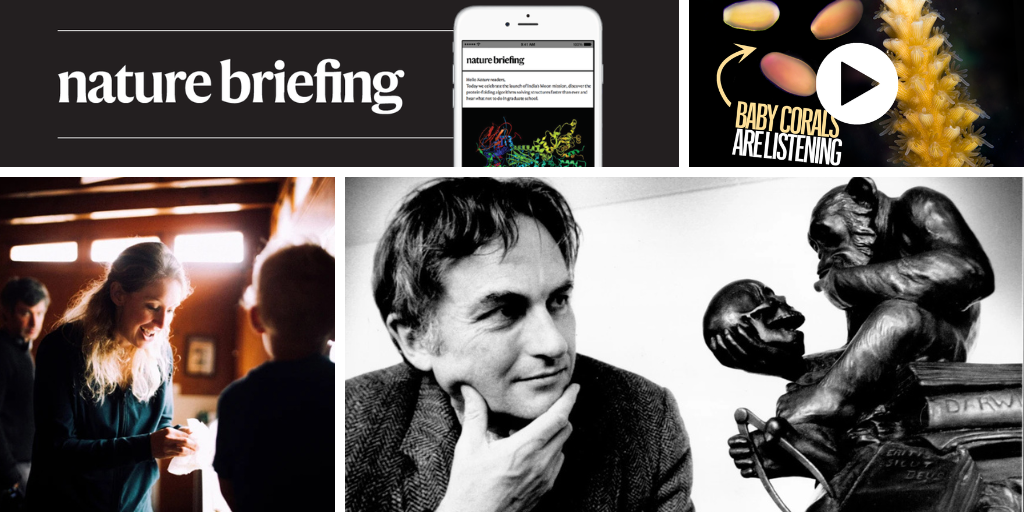
The idea set out in Richard Dawkins’s 1976 book The Selfish Gene — that bodies are just genes’ way of making more of themselves — “seemed pretty harmless”, writes historian of science Nathaniel Comfort. Today, “the determinism baked into the ‘gene’s-eye view’ in the book troubles me, as does the passivity of the organism in Dawkins’s telling”. Comfort dives into modern efforts to synthesize ecology, evolution, genetics and developmental biology to create “a less gene-centred view” that “is more accurate — and infinitely more satisfying”.
A new PhD student whose disability requires rest has found themselves in a lab where long hours are rampant, colleagues are burnt out and time off is a no-go. They ask: ‘should I risk disability stigma by disclosing to my principal investigator?’ Four researchers weigh in on how to proceed. “Regardless of what you decide about your PI, informal goodwill evaporates under pressure, while documented accommodations do not,” says management researcher Deepti Sharma.