// NATURE NEWS — SPAZIO & SCIENZA
Subcycle videography of Landau–Zener–Majorana transitions in graphene
Nature
(2026) Cite this article
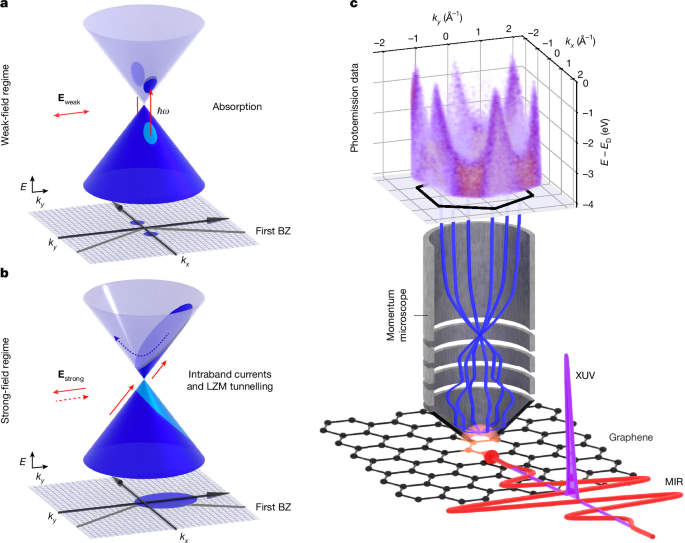
Strong light fields have unlocked entirely new possibilities to tailor coherent electron trajectories, engineer band structures and shape emergent phases of matter all-optically1,2,3,4,5,6,7,8,9. Unravelling the underlying quantum mechanisms requires a visualization of the lightwave-driven electron motion10,11 directly in the band structure. Although photoelectron momentum microscopy has imaged photoexcited electrons averaged over many cycles of light12,13,14,15,16,17,18,19, subcycle band-structure videography has been limited to small electron momenta8,20. Yet, lightwave-driven elementary processes in quantum materials often occur throughout momentum space. Here we introduce attosecond-precision, subcycle band-structure videography covering the entire first Brillouin zone and visualize one of the most fundamental but elusive strong-field processes: non-adiabatic Landau–Zener–Majorana tunnelling. The interplay of strong-field-driven acceleration within the Dirac-like band structure of graphene and periodic Landau–Zener–Majorana interband tunnelling manifests in a coherent subcycle displacement and distortion of the carrier distribution at the Brillouin zone edge. The extremely non-thermal electron distributions also allow us to disentangle competing scattering processes and assess their impact on coherent electronic control. Our panoramic view of field-driven electron motion enables a new quality of microscopic understanding of strong-field control of quantum materials.
According to the adiabatic theorem, a time-dependent, two-level quantum system remains in its ground state during a slow evolution21. By contrast, driving the system faster than its intrinsic timescale through an avoided energy crossing can create a finite occupation of the excited state by means of non-adiabatic transitions called Landau–Zener–Majorana (LZM) tunnelling22,23,24. This mechanism is central for strong-field light–matter interaction7,10,25,26. Yet, a direct observation of this foundational quantum effect in momentum space is still missing. The unique properties of graphene27 form the ideal test bed for observing LZM transitions. Its quasirelativistic electron dispersion and the robustness under irradiation with intense light have made this material a prime test ground for lightwave electronics26,28, including the demonstration of the first lightwave electronic logic gates7 and Floquet–Bloch states18,19. This has opened revolutionary prospects for quantum control, quantum sensing and quantum computation applications10,11,29.
Understanding and shaping the opportunities offered by lightwave control of electrons requires a direct observation of how LZM transitions dictate strong-field light–matter interaction. Attosecond spectroscopy has reached sufficient temporal resolution to access these dynamics30,31, and time- and angle-resolved photoemission spectroscopy (trARPES) in combination with momentum microscopy32 has visualized electron dynamics directly in the band structure of quantum materials or in the orbitals of molecular layers12,13,14,15,16,17,18,19,33. trARPES with subcycle temporal resolution8,20 has combined these approaches but offered only limited 1D momentum space access. To track coherent strong-field phenomena and scattering-induced momentum redistribution, observing carrier dynamics across the entire momentum space is imperative.
Here we expand subcycle band-structure videography to the entire first Brillouin zone (BZ). The new platform overcomes previous restrictions of momentum microscopy and subcycle ARPES, increasing the momentum area accessible with subcycle resolution by more than two orders of magnitude and the available field strengths by one order of magnitude. Exploiting few-cycle mid-infrared (MIR) field transients with large peak amplitudes, we drive coherent electron dynamics at the BZ edge of graphene. This approach reveals the simultaneous displacement and d