// SPACE.COM — SPAZIO & SCIENZA
Why does Betelgeuse keep fading? The mystery of Orion's giant star
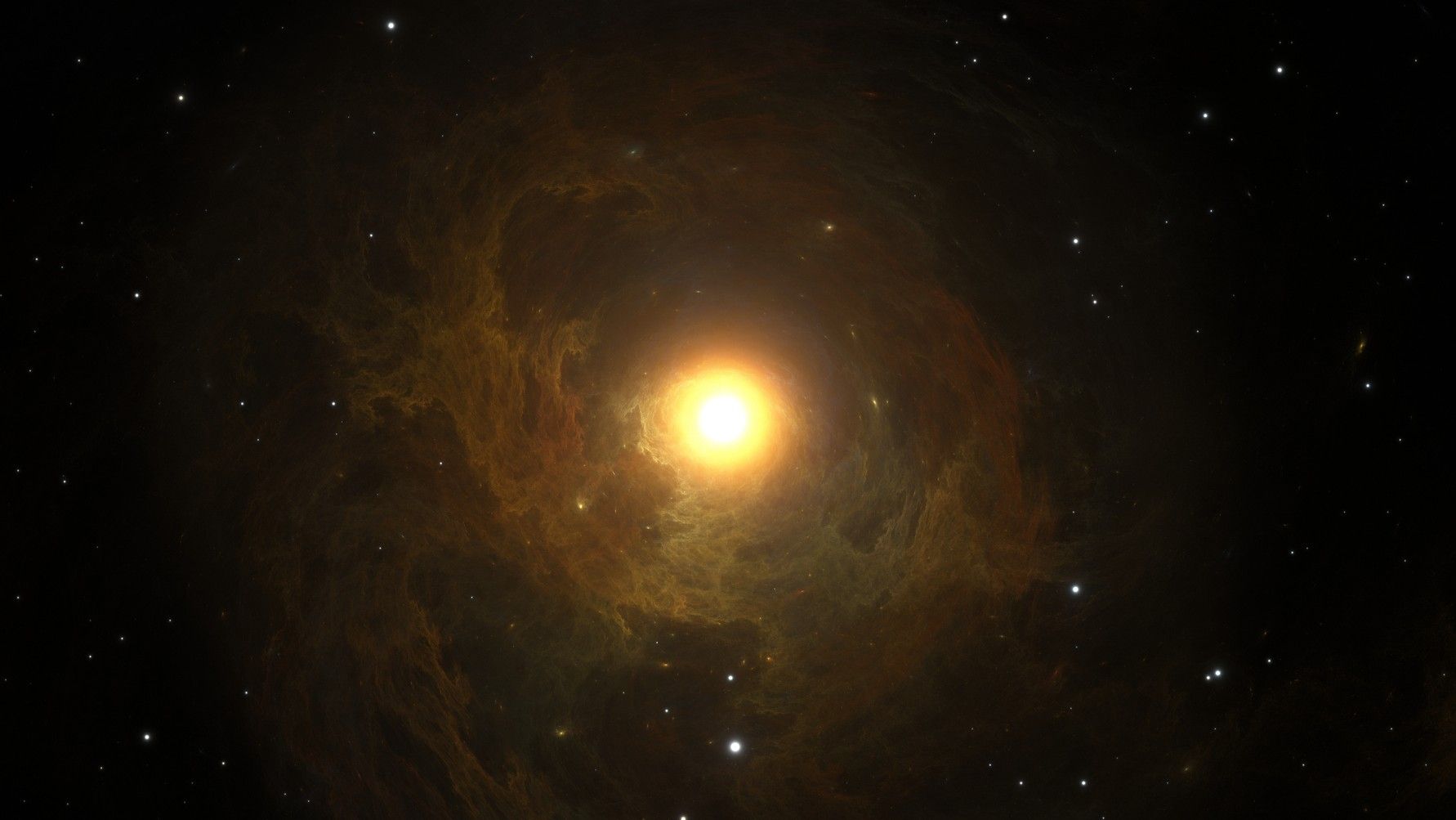
From stellar pulsations to giant dust clouds and a mysterious companion, astronomers are piecing together why Betelguese keeps changing brightness.
When you purchase through links on our site, we may earn an affiliate commission. Here’s how it works.
Betelguese, one of the brightest stars in the night sky, has been putting on quite a show lately — but not in the way you might expect.
The famous red supergiant in the constellation Orion has been growing noticeably fainter in recent months.
Of the 21 brightest stars in the night sky, Betelgeuse is perhaps the most enigmatic. Its changing brightness poses a puzzle: how do the star's pulsations, dust eruptions, and a possible companion contribute to its fading?
Even the translation of Betelgeuse's name is contentious. For a long time, it was thought to be a corruption of three Arabic words, usually translated as "The Armpit of the Giant." However, other experts in star nomenclature now dispute that interpretation, proposing instead "The Hand of al-Jauzā," with al-Jauzā referring to Orion.
Although classified as a red supergiant, Betelgeuse usually appears more orange than red— golden orange or deep topaz. It is one of the most famous stars in its class. Henry M. Neely (1877-1963), for many years a popular lecturer at New York's Hayden Planetarium, described its restless behavior in his book A Primer for Stargazers:
"(Betelgeuse) expands and contracts spasmodically, like an old man with his strength almost entirely spent, panting in the asthmatic decrepitude of old age."
Betelgeuse naturally expands and contracts like a beating heart. As an aging red supergiant, it has a regular pulsation cycle of roughly 430 days: when it expands, its outer layers cool and it dims; when it contracts, they heat up and it brightens. Among first-magnitude stars — the brightest category of stars in the night sky — it is the only marked variable. Its scale is equally remarkable: located 650 light-years away, Betelgeuse is among the largest and most luminous stars of its class, with a luminosity of about 14,000 suns at maximum and 7,600 suns at minimum. Only a few such objects have been identified in our galaxy.
British astronomer Sir John Herschel (1792-1871) first noticed Betelgeuse's variability beginning in 1836. Astronomers describe apparent brightness using magnitude: lower numbers mean brighter stars. In April 2023, Betelgeuse reached magnitude 0.0 — as bright as Vega, the fifth brightest star. At minimum brightness, such as in 1927 and 1941, its magnitude may fall to +1.2, making it appear about three times fainter.