// ITS FOSS — LINUX & OPEN SOURCE
"First We Take Manhattan": DHH on Omarchy, AI, Asahi and Winning the Linux Desktop
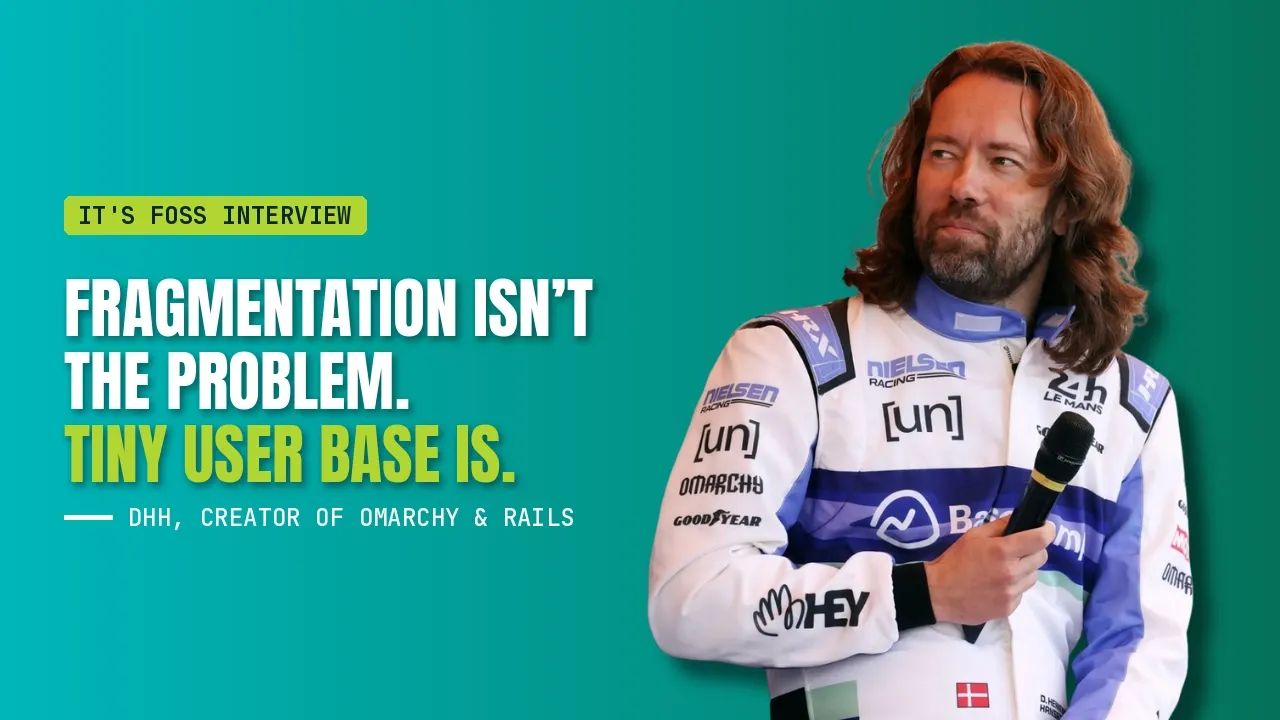
If you have followed desktop Linux this year, you could not have missed Omarchy. And if you have followed Omarchy, you could not have missed DHH.
David Heinemeier Hansson, better known as DHH, created Ruby on Rails and co-owns 37signals, the company behind Basecamp and HEY. In 2025, he released Omarchy, an opinionated Arch Linux setup built around the Hyprland tiling window manager. It looked great and had a keen following. But it was still one more Arch-based setup.
Then AI moved into its core. With Omarchy Quattro, agents became a first-class part of the desktop, and Omarchy took off. It drew in people who had never touched Linux before. Its plugin marketplace crossed 500 plugins in its first week and now has thousands, and the Omacom Foundation has more than 20 million in pledges, including AI tokens from Anthropic, OpenAI and Meta.
That rise has not been quiet. Many long-time Linux users distrust AI-generated code, and the flood of vibe coded plugins has definitely raised real security worries.
Asahi Linux, the project that makes Linux run on Apple Silicon Macs, has a no-AI contributions policy and has just moved from MIT to GPL, citing AI-assisted code laundering. And DHH, never shy of a fight on Twitter, is a polarising figure in his own right.
So I sent him questions over email about all of it: the AI bet, the Asahi licence change, plugin security, the foundation money, his critics and what comes next. Here are his answers, lightly edited for typos.
Omarchy was a nice-looking tiling setup on Arch until AI was added to its core, and then it got extremely popular, even among non-Linux users. Why do you think that happened? What did Omarchy do differently that hundreds of other distros didn't?
The age of agents is changing everything. We clearly saw its potential with Omarchy Quattro, and it's no surprise to me that anyone who's interested in agents is therefore also interested in Omarchy. We've simply made the best of a wonderful opportunity that's been offered to Linux. Meanwhile, lots of other open source projects in this ecosystem have decided to take a very anti-AI stance, and their results are as you would expect.
Ubuntu is carefully adding AI to its desktop. We have a couple of examples from China in the form of openKylin and openEuler. Other than those, I don't see any other major distros doing that. Why has no other major distro gone as far as you?
Ubuntu is built on top of GNOME, which is extremely hostile to the idea of agent development. So it's not a surprise to me that they're having a hard time integrating the best of AI into their distribution. The same goes for many other distributions that are deeply entwined with open source projects that are hostile to AI. It's difficult to fully embrace the age of agents when you're steeped in such thinking.