// SPACE.COM — SPAZIO & SCIENZA
NASA's twin ESCAPADE Mars probes slingshot around Earth in unprecedented double 'gravity assist'
When you purchase through links on our site, we may earn an affiliate commission. Here’s how it works.
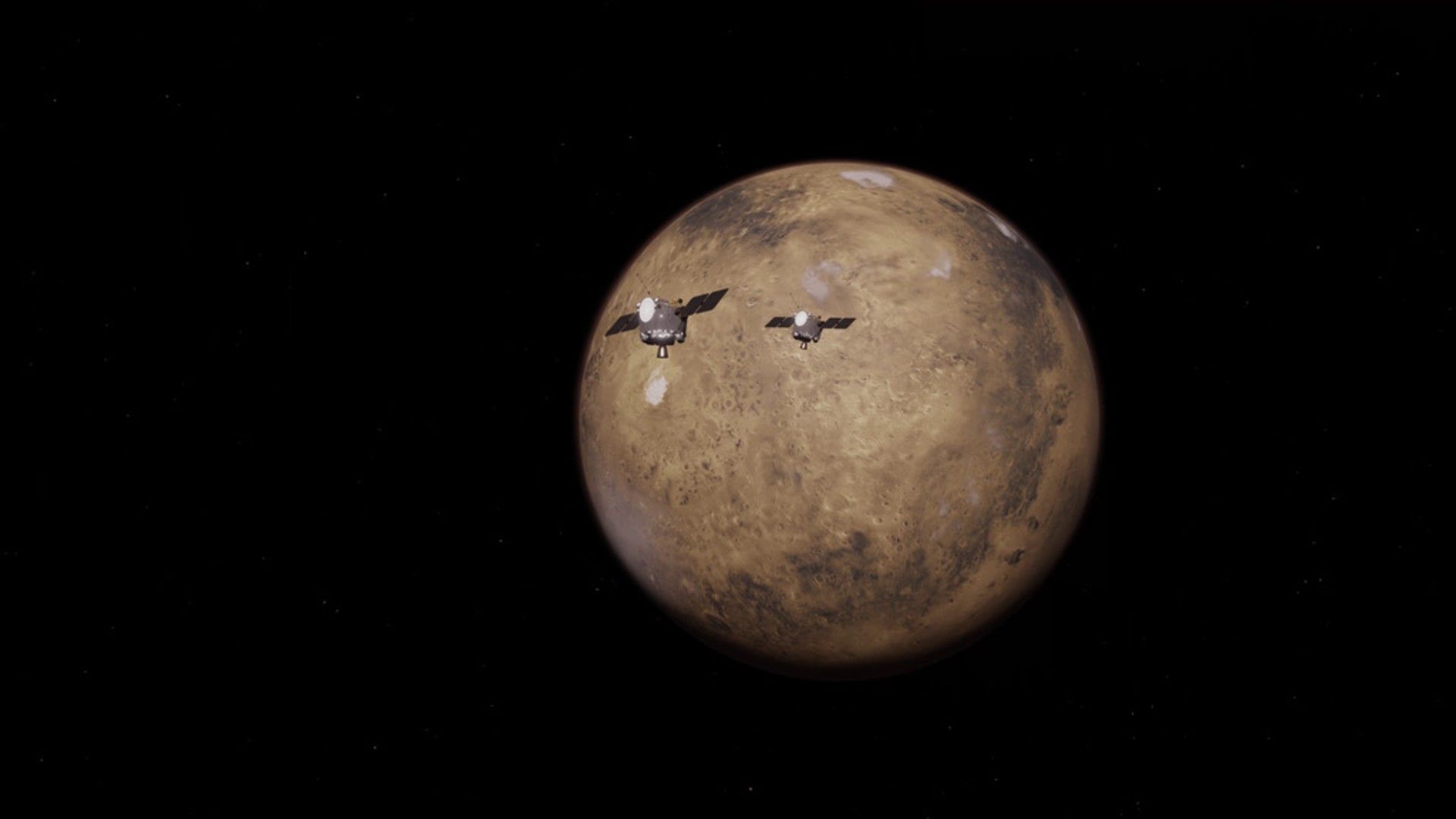
Twin NASA spacecraft are wrapping up a year-long escapade, ready to make a beeline to the Red Planet.
The Escape and Plasma Acceleration and Dynamics Explorers (ESCAPADE) spacecraft launched in November 2025 on the second-ever flight of Blue Origin's New Glenn rocket. But rather than head straight to Mars, the two spacecraft dawdled through a looping trajectory. Now, they are back in Earth's neighborhood where they tackled a crucial engine burn unusually close to Earth that — if all goes well — will set them on track for Mars.
"No NASA mission has ever done this before," said Rob Lillis, a planetary and space physicist at the University of California, Berkeley and principal investigator of the ESCAPADE mission. "For most missions, it just isn't necessary."
That's because traditionally NASA's Mars missions have been carefully choreographed within cosmic launch constraints, leaving Earth during a brief window of planetary alignment that only occurs every 26 months. ESCAPADE was meant to launch in October 2024, when Earth and Mars were favorably aligned, but delays with the New Glenn rocket forced the mission to sit out the precious launch window.
Rather than wait to launch this fall, NASA decided to try something new. ESCAPADE mission planners designed a "loitering" orbit, shaped like a kidney bean. It called for the twin probes to loop through that trajectory to be back at Earth in early November 2026, ready to continue on to Mars.
Once they arrived, however, the twin probes faced a major hurdle: Each had to perfectly execute an engine burn within Earth's gravity well. The maneuver is similar to the slingshot flybys that spacecraft regularly conduct to adjust their trajectories — but here, the probes had to fire their engines to amp up the effect of the burn rather than acting alone.
The first spacecraft tackled the feat on Nov. 7; the second did so on Monday (Nov. 9). And according to NASA, the burns went perfectly. "This is the first time NASA has used a powered Earth flyby to propel a spacecraft toward Mars, and we've now executed this maneuver twice, flawlessly, in just two days," Asal Naseri, acting associate flight director for NASA's Heliophysics Division said in a statement.
After just a few minor course corrections, ESCAPADE will be sailing toward a September 2027 Mars arrival.
The twin ESCAPADE spacecraft have made the most of their extended tour. Each spacecraft is about the size of two refrigerators and equipped with three scientific instruments and a couple cameras. All are tailored for studying the strange magnetic field of Mars, which is created both globally by charged particles from the sun interacting with the atmosphere and locally by areas of highly magnetic crust.