// ENGADGET — INTELLIGENZA ARTIFICIALE
A Chinese team made a big splash with a drone swarm world record
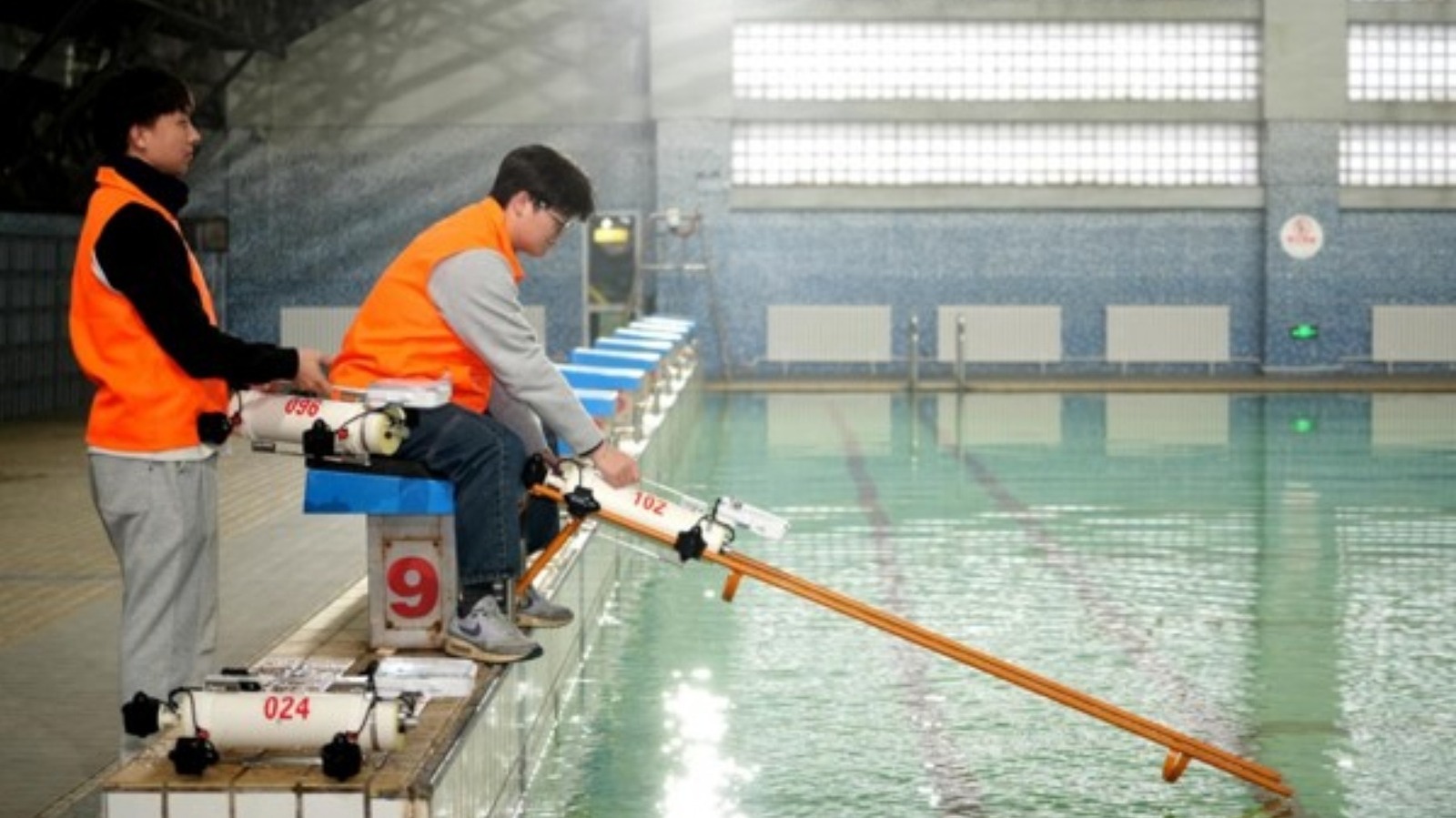
Researchers have set a record for the largest swarm of underwater drones in history. Officially recognized by Guinness World Records, the trial saw 116 TH-618 drones deployed in a 164 ft by 65 ft pool, where they autonomously executed a series of formations and maneuvers. (For comparison, and Olympic-sized swimming pool is approximately 164 ft by 82 ft.)
The August 2026 test has strong ties to the People's Republic of China's military pipeline. It was conducted by researchers at Northwestern Polytechnical University, an institution designated by the US government as a developer of technologies for the People's Liberation Army (PLA). The university conducted the experiment in conjunction with Xi'an Tianhe Maritime Technologies, a subsidiary of defense contractor Xian Tianhe Defense Technology.
According to the South China Morning Post, the university said that developing submersible drone swarms "has always been a core challenge in the global field of underwater intelligent equipment. This time, the stable navigation of a cluster of hundreds of vehicles represents a breakthrough in the large-scale coordinated navigation of underwater unmanned systems."
The record-setting day could prove a major milestone in the PLA's development of autonomous drone swarms — an increasingly vital point of emphasis in the Eastern power's military buildup. Currently the world's largest navy, the PLA Navy (PLAN) is largely made up of smaller nimble ships designed to patrol the contested littoral waters of the South China Sea. And while the nation has commissioned three aircraft carriers in the last decade and a half, its fleet still lags behind the United States in total fire power.
Some believe drones could close this gap and enable PLA's increasingly expansive naval ambitions. Others worry the proliferation of drones will lower the threshold for naval engagements at a a time when naval intelligence is already beset with uncertainty.
The test's TH-618 drones resemble long pipes equipped with four propellers and a camera. Roughly 2 ft long and half a foot wide, the 11lb drones have a range of just over 18 miles and can operate continuously for roughly 8 hours. To navigate, the drones use smartphone cameras attached to the front, allowing AI systems to adjust routes in real time to respond to underwater disturbances and collisions. According to the university, the drones can autonomously conduct complex maneuvers like terrain tracking, landmark recognition, vertical lift, depth and speed control and hovering in water using multi-degree-of freedom thrusters.
Underwater drone navigation is exceedingly complex when compared to its aerial counterpart because developers cannot utilize wireless communications or satellite positioning and navigation systems for course calibration. Low visibility and high water pressure further complicate subsurface coordination. Drones must rely on an amalgamation of underwater sensing, subsurface target detection and acoustic communication to autonomously respond to their irregular operating environment. Coordinating these efforts is another challenge altogether.
The culmination of over two decades of research, this record-breaking exercise could represent a major leap in AI-powered underwater navigation technologies. Over roughly 34 minutes, the drones relied solely on visual data to autonomously navigate around the pool, covering over 1,600 feet without human intervention. In creating a miniaturized submersible capable of coordinating autonomous responses to environmental stimuli, researchers at NWPU may have taken a step towards a new era of subsurface research, intelligence gathering and warfare.
Of course, these technologies have a long way to go before they revolutionize China's naval operations. The controlled environment of a pool is a poor facsimile for proving the seaworthiness of autonomous submarine swarms. However, the test may indicate the direction of China's subsurface and drone development program