// NATURE NEWS — SPAZIO & SCIENZA
Bistable regulation of adipocyte heterogeneity governs thermogenesis
Nature
(2026) Cite this article
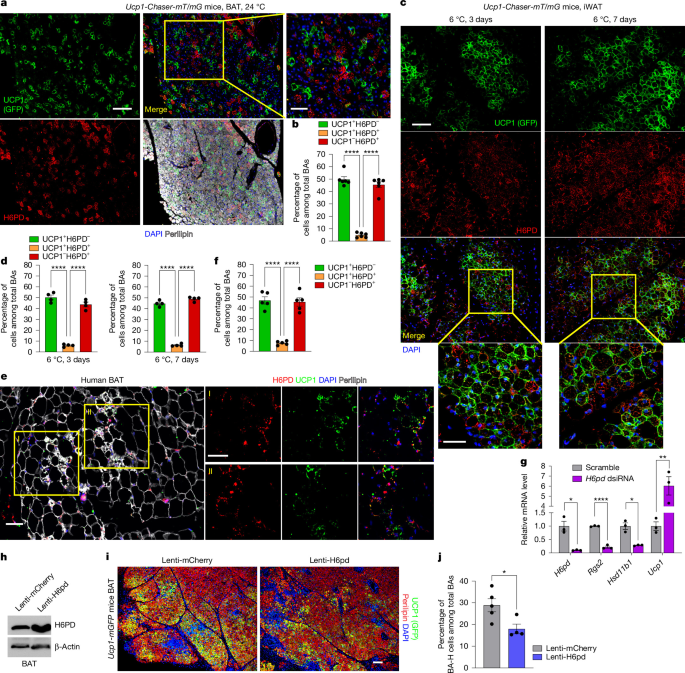
Brown adipocytes (BAs) are thermogenic cells that regulate energy homeostasis, and age-related declines in thermogenesis contribute to cold sensitivity1,2,3,4,5. We previously identified a BA subpopulation with low UCP1 expression (hereafter, BA-L cells) that coexists with the classical, high-UCP1-expressing BAs (hereafter, BA-H cells)6. Here we show that IL-1β secreted by neutrophils and macrophages stabilizes nearby BAs in the BA-L state. Specifically, IL-1β stabilizes hexose-6-phosphate dehydrogenase (H6PD) protein from degradation to ensure the generation of active glucocorticoids, which activate the glucocorticoid receptor (GR, encoded by Nr3c1) and increase the expression of its target gene, regulator of G-protein signalling 2 (Rgs2), thereby suppressing UCP1 expression. Cold exposure reduces IL-1β levels, depending on sympathetic innervation, leading to H6PD degradation and the conversion of BA-L cells to BA-H cells, thereby enhancing UCP1-dependent thermogenesis. Rising environmental temperatures trigger the opposite events. BA-specific inducible deletion of Nr3c1 during cold exposure locks these cells in the BA-H state, leading to persistent thermogenesis and increased energy expenditure days after the mice return to room temperature. Notably, IL-1β is elevated in aged brown adipose tissue, resulting in a locked low BA-H/BA-L ratio and cold intolerance. Suppressing GR in aged mice restores the BA-H/BA-L ratio, resumes thermogenesis and increases energy expenditure. Our findings reveal a spatiotemporal neuronal–immune regulation of BA heterogeneity that governs thermogenesis and offers a fundamental understanding of the mechanisms underlying increased cold sensitivity in older individuals.
Functional cellular heterogeneity is well documented in hepatocytes, driven by liver zonation7, and in muscle fibres, shaped by local environmental cues, particularly motor neuron activity8. Single-cell technologies have revealed extensive new patterns of heterogeneity of specific cell types within the same tissue9, yet their biological importance remains largely undetermined.
Thermogenic adipose tissue undergoes adaptive thermogenesis and is crucial for energy expenditure and thermoregulation1,2. Its specialized metabolism and precise responses to environmental and physiological stimuli make it an ideal model for studying functional cellular heterogeneity. Thermogenic capacity declines substantially with age in rodents and humans, leading to age-related cold sensitivity and metabolic disorders3,4,5, yet the underlying mechanisms remain unclear.
BAs and beige adipocytes mediate UCP1-dependent non-shivering thermogenesis10. Although substantial progress has been made in identifying the key pathways that activate thermogenesis, most studies have been conducted at the whole-tissue level, leaving the mechanisms governing its activation, maintenance and deactivation incompletely understood.
The heterogeneity of BAs within the same brown adipose tissue (BAT) and beige adipocyte cluster within inguinal white adipose tissue (iWAT) has been characterized by our group6 and others5,11,12,13,14. We found that BAs heterogeneously express UCP1 and classified those with low expression as BA-L cells and those with high expression as BA-H cells6. At room temperature, BA-H cells constitute 30–50% of all BAs; BA-H cells predominate after cold exposure, whereas BA-L cells predominate under thermoneutral conditions6. This raises questions of why BA heterogeneity exists, and whether it reflects random variation along a thermogenic continuum or spatially organized, tightly regulated states within the tissue.
Here we identify dynamic bistable regulation of BA heterogeneity controlled by the spatial proximity of BAs to IL-1β puncta through a neuronal–immune regulatory mechanism. This regulation becomes dysfunctional during ageing, leading to cold intolerance in older adults. These findings hi