// NATURE NEWS — SPAZIO & SCIENZA
Epigenetic heterogeneity in breast tumours informs diagnosis and prognosis
Nature
(2026) Cite this article
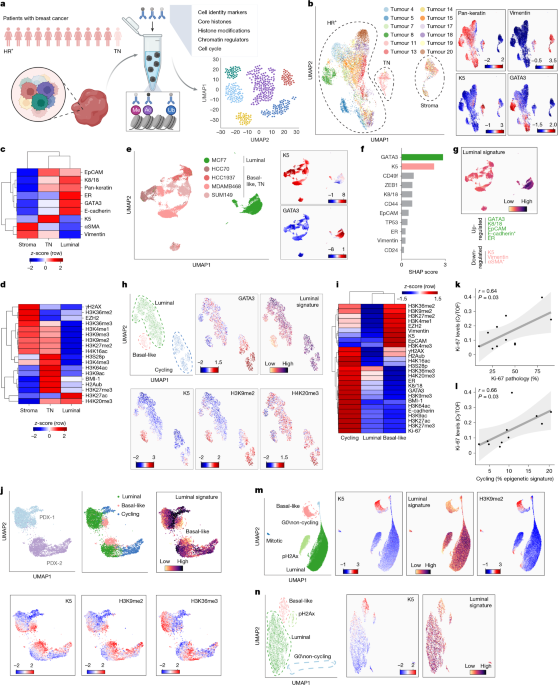
Breast cancer, the most diagnosed cancer among women, is stratified by gene expression patterns into luminal and basal-like subtypes, and the latter is associated with worse prognosis1,2,3. Recent advances in single-cell technologies have underscored the presence of intratumour heterogeneity, which poses substantial challenges in cancer treatment and achieving long-term disease-free survival4,5,6,7. Here we extensively profile epigenetic heterogeneity in a cohort of treatment-naive human luminal tumours, which were obtained directly after surgical resection. By applying a single-cell epigenetic approach based on cytometry by time-of-flight, we identify a recurrent subpopulation of basal-like cells in luminal tumours with a conserved epigenetic signature across patients. These basal-like cells, also identified by deconvolution of whole-genome DNA methylation patterns, are characterized by high expression of aggressive oncogenic traits and downregulation of hormone receptor signalling. Direct comparison of single-cell proteomic and genomic profiling of monomethylation and trimethylation of histone 3 on lysine 4 revealed that these marks are key features associated with loss of luminal identity. Finally, we highlight the potential of concomitant single-molecule profiling of histone modifications on cell-free nucleosomes in blood as an epigenetic liquid biopsy approach for early diagnosis of breast cancer. Moreover, the epigenetic basal signature measured in blood is linked to prognosis, which enables the identification of patients at increased risk for disease relapse.
Gene expression profiles classify breast cancers into luminal A or luminal B (hormone-receptor-positive (HR+)), HER2-positive and basal-like subtypes. Among these, basal-like subtypes largely overlap with triple-negative breast cancer (TNBC)2,3. These classifications guide treatment management and prognosis. Luminal HR+ breast cancer generally responds to endocrine therapy with favourable outcomes, yet many patients relapse8. Single-cell and spatial studies have revealed substantial intratumoural heterogeneity among subtypes, which potentially drive treatment resistance and recurrence4,5,6,7,9.
Chromatin organization, mediated by DNA and histone post-translational modifications (PTMs), facilitates the acquisition of epigenetically distinct cellular states in genetically identical cells10,11,12. Although single-cell RNA sequencing (scRNA-seq) and single-cell chromatin-accessibility sequencing (scATAC–seq) delineate intratumour heterogeneity13,14,15,16, the contribution of chromatin patterns remains unclear17. Single-cell profiling of histone marks, such as trimethylation of histone 3 on lysine 27 (H3K27me3), implicates chromatin states in breast tumour heterogeneity and treatment resistance18,19. However, these methods measure a limited number of chromatin marks, which hinders analyses of complex patterns and interactions. We developed a cytometry by time-of-flight (CyTOF) method to systematically profile multiple histone PTMs and decode population-specific chromatin patterns to examine heterogeneity among cancer cells20,21,22,23.
Tumour epigenetic states are also reflected in blood. Cell-free, plasma-circulating nucleosomes, released mainly by dying normal and cancer cells, retain tissue-of-origin epigenetic patterns24,25,26,27. Our single-molecule imaging platform, epigenetics of plasma isolated nucleosomes (EPINUC), captures multiple epigenetic features on plasma nucleosomes28. This method detects colorectal cancer, including low-burden early-stage disease28, and enables minimally invasive molecular profiling and treatment monitoring of paediatric brain tumours29.
Here we present a holistic epigenetic analysis of primary treatment-naive breast tumours and blood cell-free nucleosomes. Linking recurrent intratumoural epigenetic patterns to circulating nucleosomes connects tumour epigenetic heterogene