// NATURE NEWS — SPAZIO & SCIENZA
Suppression of epithelial proliferation and tumorigenesis by IgA
Nature
(2026) Cite this article
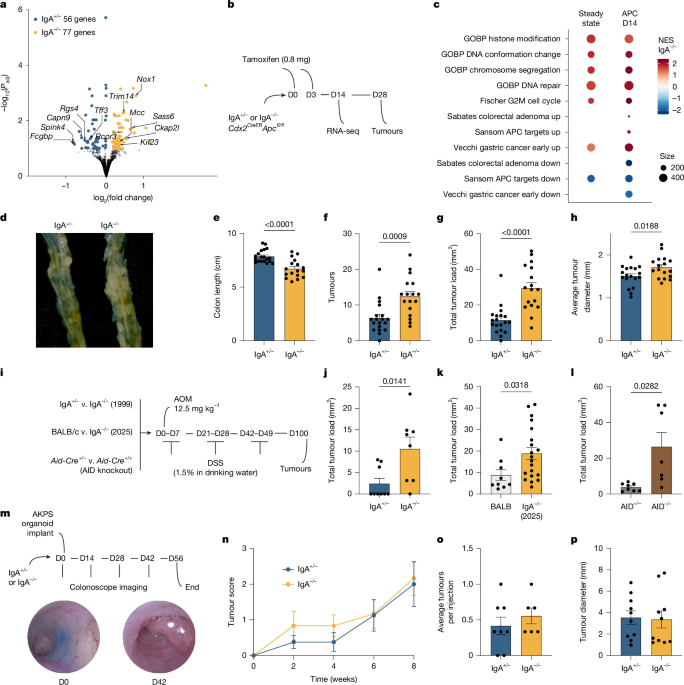
Immunoglobulin A (IgA) is the most abundant antibody isotype produced by mammals, and has a specialized role in mucosal homeostasis1. IgA is constantly secreted into the intestinal lumen and binds to commensal microorganisms to regulate their colonization and function2,3, with unclear implications for health. IgA deficiency is common in humans, but difficult to study, because of its complex aetiology and comorbidities4,5,6,7,8. Here we use genetically and environmentally controlled mice to show that various models of IgA deficiency result in increased susceptibility to several models of endogenous colorectal cancer. Cellular and molecular analyses revealed that, in the absence of IgA, colonic epithelial cells induce antibacterial factors and accelerate cell cycling in response to the microbiota. Oral treatment with IgA was sufficient to reduce steady-state proliferation and protect mice from tumours; however, this function was due to the structure of the antibody rather than to binding specificity. In a reductionist culture system, IgA directly suppressed epithelial growth. Co-immunoprecipitation mass spectrometry and targeted CRISPR screening identified DMBT1 as an IgA-binding epithelial surface protein that is required for IgA-mediated suppression of proliferation. Together, IgA and DMBT1 tune the normal cycling of absorptive colonocyte progenitors. In IgA-knockout mice, deleting the transmembrane and cytoplasmic signalling portions of DMBT1 was sufficient to reverse both the increased epithelial cell proliferation and the increased tumour susceptibility seen in these mice. These experiments establish a homeostatic function for IgA in tempering physiological epithelial responses to the microbiota to maintain mucosal health.
This is a preview of subscription content, access via your institution
Access Nature and 54 other Nature Portfolio journals
Get Nature+, our best-value online-access subscription
Prices may be subject to local taxes which are calculated during checkout
All raw sequencing data for bulk RNA-seq, 16S rRNA amplicon sequencing and single-cell RNA-seq are available via the NCBI Sequence Read Archive (SRA) under a unified project: PRJNA1023250. The following freely accessible databases were also used: UniProt (https://uniprot.org), Tabula muris and Tabula sapiens (https://biohub.org) and GSEA gene sets (https://gsea-msigdb.org). Source data are provided with this paper.
Fagarasan, S. Evolution, development, mechanism and function of IgA in the gut. Curr. Opin. Immunol. 20, 170–177 (2008).
Article
CAS
PubMed
Google Scholar
Pabst, O. & Slack, E. IgA and the intestinal microbiota: the importance of being specific. Mucosal Immunol. 13, 12–21 (2020).