// NATURE NEWS — SPAZIO & SCIENZA
Evolutionary dynamics in the years preceding acute myeloid leukaemia
Nature
(2026) Cite this article
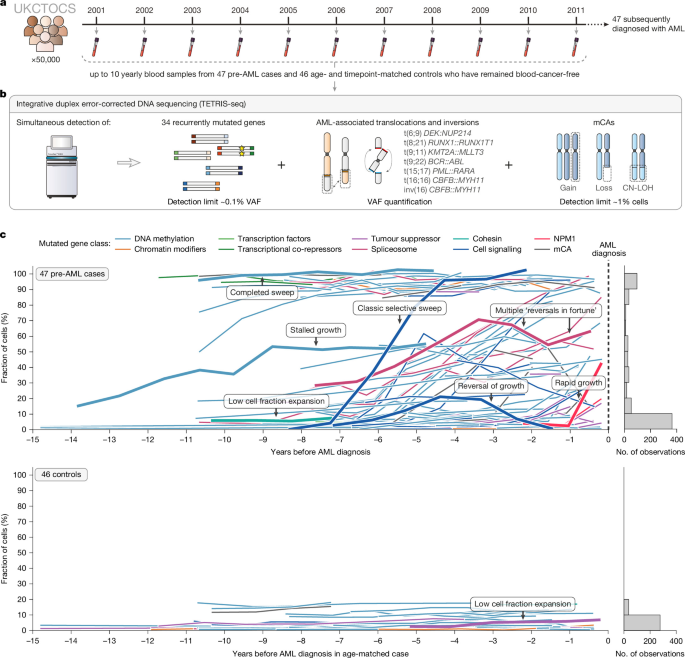
Somatic evolution in ageing tissues underlies many cancers1,2. However, our quantitative understanding of the rules governing this pre-cancerous evolution remains incomplete. Here we exploit a unique collection of serial blood samples3, collected annually for up to a decade and beginning as early as 15 years before diagnosis of acute myeloid leukaemia, to provide a quantitative description of pre-cancerous evolutionary dynamics. Using deep duplex sequencing and evolutionary theory, we quantify the acquisition ages and fitness effects of the key driver events in acute myeloid leukaemia development. The first driver mutations are typically acquired in the first few decades of life, when the blood remains highly polyclonal. These early slow-growing clones subsequently acquire multiple further driver mutations that confer selective advantages up to 100-fold larger than the early drivers. These faster-growing clones harbouring multiple driver mutations can cause complete somatic sweeps of the blood decades before diagnosis, a feature strongly associated with future acute myeloid leukaemia. Our data show that the clonal dynamics of blood are consistent with a set of remarkably simple evolutionary rules that strike a balance between chance and determinism.
Cancers develop through a process of Darwinian evolution within tissues1,4,5,6. Mutation, drift and selection in the large cell populations making up our tissues can result in the emergence of a clone that has acquired multiple genetic and epigenetic ‘driver’ alterations that disrupt tissue homeostasis and promote uncontrolled proliferation7,8,9,10. Although large-scale sequencing efforts over the last 20 years have provided comprehensive catalogues of the driver genes responsible for cancer development11,12,13, a complete quantitative understanding of the evolutionary dynamics governing how these drivers arise, expand and compete is lacking. Why are cancer driver mutations widespread across many healthy human tissues2,14,15,16,17, yet cancers of many of these tissues are comparatively rare? Why in some people do initial clonal expansions progress to lethal cancers whereas in others they remain benign? What are the relative roles of chance and determinism in the evolution of cancer? Answers to these questions could guide more rational approaches to early cancer detection18, risk prediction19,20,21,22,23 and personalized intervention24,25.
Theories of oncogenesis on the basis of somatic evolution have existed since the 1950s and were used to explain the nonlinear increases in cancer incidence with age26. These multi-stage models highlighted important roles for mutation26,27, selection28,29 and stem-cell population sizes30. However, these models have proven difficult to falsify with age-incidence data alone. The dynamics of molecular evolution, read-out using deep sequencing of serial samples, provide a more direct measure of the evolutionary dynamics and have transformed our understanding of microbial evolution31,32,33,34,35. Applying similar approaches to cancer development, however, has proven challenging as serial samples of pre-cancerous tissue from asymptomatic individuals are difficult to obtain. Even when these tissues are available, they typically provide only a static snapshot of the somatic diversity present. To better understand the dynamics of pre-cancerous evolution requires serial samples collected with high temporal resolution.
The haematopoietic system provides a unique opportunity to understand and quantify pre-cancerous evolution because serial blood samples in asymptomatic individuals can be collected antecedent to cancer development. Healthy blood displays ubiquitous and pronounced age-related changes driven by positive selection for genetic alterations that are recurrently mutated in acute myeloid leukaemia (AML) (for example, DNMT3A, TET2 and ASXL1)19,20,21,22,23,36,37. This phenomenon, termed clo