// SPACE.COM — SPAZIO & SCIENZA
Astronomers trace mystery radio signals back to cosmic odd couple of white dwarf and sun-like star
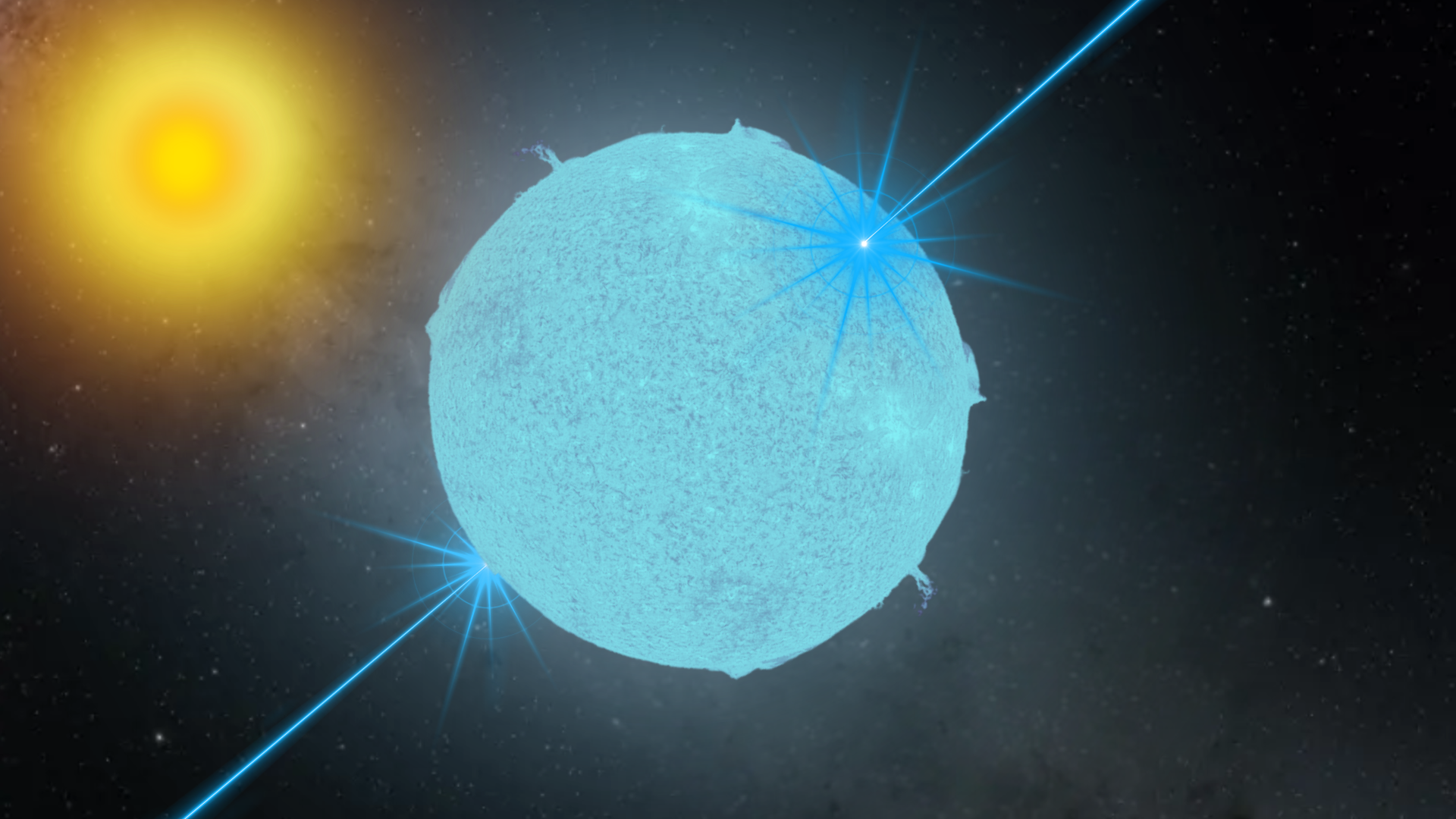
"It’s amazing that by using radio wavelengths, we can detect the storms on a star over 5,000 light-years away."
When you purchase through links on our site, we may earn an affiliate commission. Here’s how it works.
Astronomers have traced a mysterious radio signal back to a cosmic odd couple comprised of a dead star, a white dwarf, and its stellar companion, a sun-like star.
The white dwarf in the newly discovered system, designated GPM J071507−114153 and located around 5,000 light-years away, spins once every eight minutes, sending out radio pulses. These radio pulses have been seen from binary systems with smaller and cooler red dwarf stars before, but rarely from a system like GPM J071507−114153.
GPM J071507−114153 belongs to a class of celestial objects called long-period transients (LPTs) known to produce radio signals that switch on and off over intervals of minutes or hours. Around a dozen LPTs have been detected since the team behind this research found the first in 2021. Several previously discovered LPT systems contain a white dwarf and a companion star, but it has been unclear which of the two stars was generating the radio pulses. That means the discovery of GPM J071507−114153 and finding that the pulses come from close to the white dwarf could be a significant step toward understanding the nature of LPTs.
"This is the first time the pulses are clear enough to see the white dwarf moving in its orbit around its companion," team leader and commissioning scientist with the Square Kilometre Array Observatory (SKA), Sam McSweeney, said in a statement. "So we know that the pulsations are coming from a region close to the white dwarf, or possibly even from the white dwarf itself."
The pulses seen by the team also allowed them to detect stellar flares erupting on the sun-like star.
"As a bonus, we also saw the white dwarf moving behind a region with a strong magnetic field, most likely a 'stellar prominence,' which is a large loop of plasma erupting from a star's surface," team member Natasha Hurley-Walker of the International Centre for Radio Astronomy Research (ICRAR), Curtin University, Australia, said. "It's amazing that by using radio wavelengths we can detect the storms on a star over 5,000 light-years away."
Hurley-Walker and the team at ICRAR have been at the cutting edge of rare star systems like this.
"We detected this system in a large survey using the Murchison Widefield Array (MWA) to scan the entire Milky Way visible from Australia," Hurley-Walker said. "We then used the MeerKAT radio telescope in South Africa to determine its precise position."