// NATURE NEWS — SPAZIO & SCIENZA
Closest relatives of poxviruses prevail in human and animal guts worldwide
Nature
(2026) Cite this article
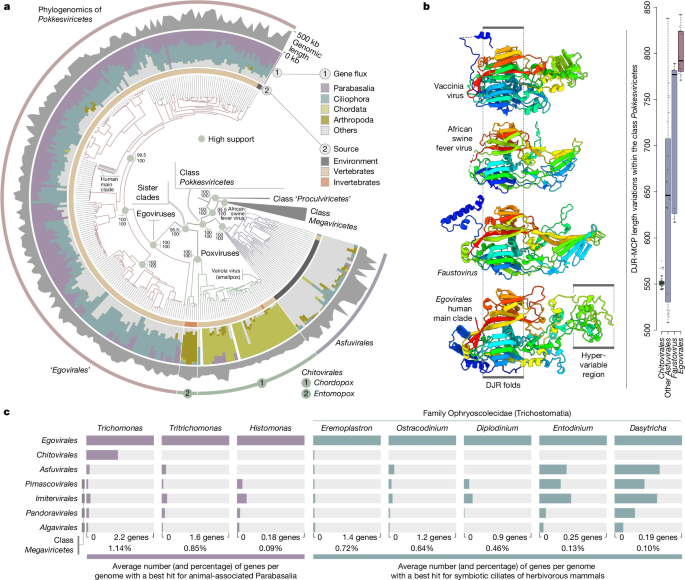
Large and giant double-stranded DNA viruses substantially affect eukaryotic ecology and evolution1,2,3,4. They prevail in the environment but are rarely found in the digestive system of animals5,6. Here we present the discovery of a diversified group of DNA viruses with large linear genomes, dubbed egoviruses, that comprise a putative viral order most closely related to animal-infecting poxviruses. Egoviruses are found worldwide, almost exclusively in the digestive system of humans, livestock and wild animals. The most prevalent human-specific egovirus is spread across continents, demonstrating a long-term association between egoviruses and the human gut microbiome. Eukaryotic homologues of egovirus core genes suggest that these viruses primarily infect Trichostomatia (ciliates), which assist ruminant digestive processes7, and Parabasalia (Metamonada), which influence animal immunity and gut microbiome ecology8. Egoviruses also contributed to the genetic makeup of polintons, endogenous viruses that proliferated in genomes of Trichomonas vaginalis9 and its close Parabasalia relatives. Unlike poxviruses that form brick-shaped virions, egoviruses are predicted to form multilayered icosahedral capsids resembling those of asfuviruses and probably representing the ancestral virion structure. Egoviruses are the only known clade of double-stranded DNA viruses of eukaryotes prevailing in the animal digestive system. Phylogenomic analysis suggests an evolutionary scenario whereby egovirus-like ancestors of poxviruses infected anaerobic unicellular eukaryotes inside the gut of ancestral animals, before transitioning to animal cell infection, which was accompanied by the virion metamorphosis.
Pokkesviricetes is a class of eukaryotic viruses with large, linear double-stranded DNA genomes within the phylum Nucleocytoviricota. The class is divided into two orders, Chitovirales (poxviruses) and Asfuvirales10. Poxviruses infect a broad diversity of animals including humans11. They include the now eradicated smallpox virus, monkeypox viruses that continue to sporadically infect humans, and molluscum contagiosum virus, causing benign tumours in immunocompromised individuals, as well as vaccinia virus, a classic model of molecular virology12,13,14. Asfuviruses infect hosts ranging from unicellular eukaryotes to animals15 and include the African swine fever virus, which causes deadly and economically important outbreaks in pigs and boars16, as well as a wider range of viruses mostly characterized in coculture with free-living amoeba15,17 or directly from the environment (for example, from plankton) using genome-resolved metagenomics6,18,19. Apart from the few viruses of global concern, as declared by the World Health Organization, the class Pokkesviricetes is of great importance for our understanding of the diversity, ecology and evolution of eukaryotic, and in particular animal, DNA viruses20,21.
The evolutionary trajectory of nucleocytoviruses leading to the emergence of animal-infecting poxviruses remains enigmatic. Animals emerged roughly 700 million years ago22 and host a variety of symbiotic unicellular eukaryotes that for the most part reside in their digestive system23,24,25, representing prime candidates for the ancestral hosts of poxviruses. Indeed, host transition from unicellular eukaryotes to animals would be greatly facilitated by a lasting period of close interactions allowing adaptation to the internal environment of the latter. Yet decades of investigations using cultivation, PCR surveys, serology and metagenomics indicated that nucleocytoviruses are mainly transient and thus rarely abundant in the digestive system of humans and other animals5,6,26. Until now, not a single group of Nucleocytoviricota was found to be commonly associated with or prevalent in the digestive system, contrasting with the broad distribution and remarkable diversity of these viruses in the en