// ARS TECHNICA — HARDWARE & GADGET
The world's biggest solar telescope caught vortexes on the Sun's surface
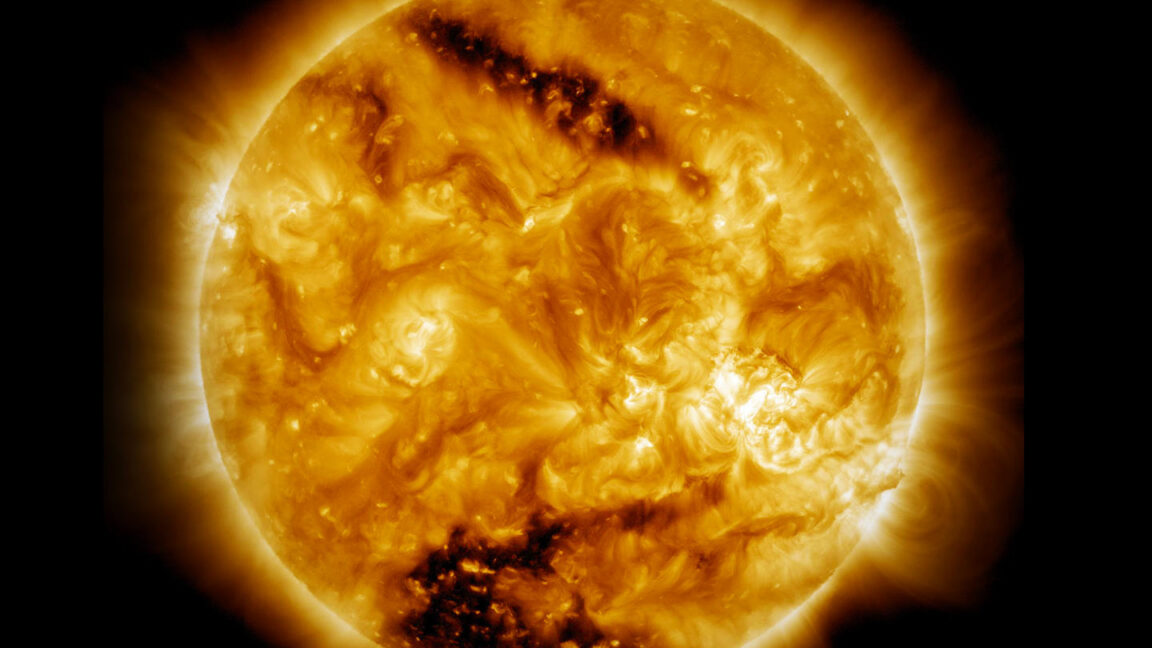
We expected them to be there, but they had previously been too small to see.
Wherever two fluids slide past each other at different speeds, the boundary between them buckles, then curls, then rolls up into vortexes. It’s called the Kelvin-Helmholtz instability, and the physics behind it was worked out in the late 1860s. We know this instability explains why wind causes ripples on the surface of water and clouds shear into a row of curves.
For decades scientists argued the same thing must be happening with plasma on the surface of the Sun, and yet nobody had been able to confirm it. Now, a team led by David Kuridze and Friedrich Wöger of the National Solar Observatory reports that Kelvin-Helmholtz instabilities are not just visible on the Sun, but they’re ubiquitous. Their new study proposes that this may change the way we think about how heat, mass, and magnetic energy move through the Sun’s atmosphere.
The reason plasma whirlpools on the Sun stayed hidden for so long is rather trivial: they are very small. Their scale sits below what telescopes with mirrors smaller than 2 meters can resolve. For most of the history of solar physics, that has ruled out every telescope on Earth. This changed when the US National Science Foundation opened the Daniel K. Inouye Solar Telescope, a 4-meter instrument in Hawaii and the largest solar telescope in the world. The telescope entered its operational phase back in November 2021.
During a three-minute window on April 14, 2025, Kuridze’s team pointed it at an active region near the center of the solar disk and recorded images at a wavelength of 416 nanometers using a diagnostic camera setup built jointly by the National Solar Observatory and the Max Planck Institute for Solar System Research. They were not looking for vortexes, though. “The main goal was to achieve diffraction-limited performance with the telescope,” Kuridze says.
Every telescope has a diffraction limit, the finest detail its optics can physically deliver. It’s set by two things: the size of the mirror and the wavelength being observed. The bigger the mirror and the shorter the wavelength, the finer the detail we can observe. The mirror at the Inouye telescope was fixed at 4 meters, so the team pushed on the wavelength. “416 nanometers is towards the smaller portion of the visible spectrum,” Kuridze says. “We selected it because we wanted to achieve a higher diffraction limit and higher resolution.”
What they got in the end, though, was something more than just a cool test drive. The camera read out 740 frames per second with exposures of 100 microseconds. Two thousand of those frames were combined into a final image using a technique called multi-frame blind deconvolution, which numerically models and removes the blurring left over by Earth’s atmosphere after the telescope’s optics have done their work. The result was a movie of the solar surface with a new frame every two seconds and a spatial resolution of about 19 kilometers—right at the theoretical limit of what a 4-meter mirror can do at that wavelength.
“As a byproduct we got these amazing observations, which allowed us to see something which has never been seen before,” Kuridze says.
At 416 nanometers, the solar surface is dominated by granules, the convection cells that carry heat from the interior. They’re interlaced with concentrated bundles of intense magnetic fields. In lower-resolution images, the interface between a bundle of these magnetic fields and the surrounding granulation looks smooth and slightly blurry.
The interfaces are composed almost entirely of vortex-like structures and fine dark striations. The team identified 47 of these vortex-bearing interfaces in the telescope’s field of view and measured the spacing between adjacent curls. It turns out they’re usually between 60 and 100 kilometers apart, with individual vortexes measuring from 25 to 170 kilometers in diameter. The smallest ones scientists could spot sat right at the 19-kilometer re