// NATURE NEWS — SPAZIO & SCIENZA
Cascading continental-scale floods across Europe in 1342–1343
Nature
(2026) Cite this article
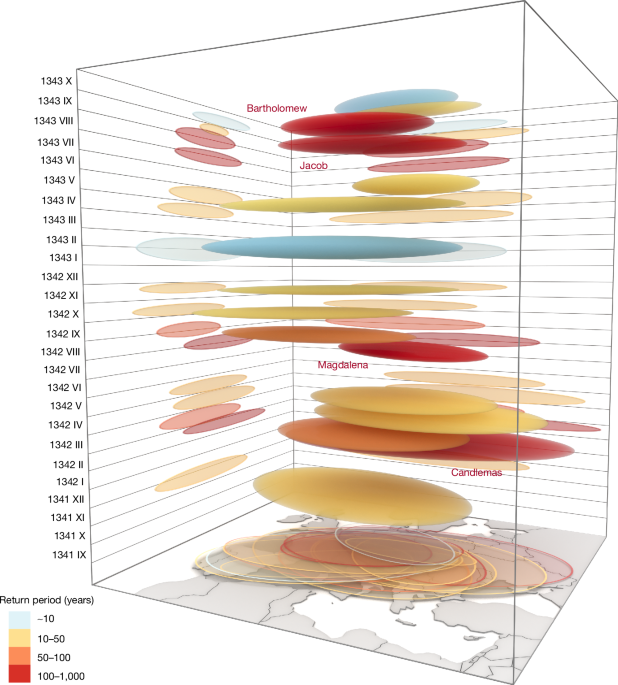
Europe has experienced extreme floods in recent decades. However, even larger floods are possible and must be considered in flood risk management1,2. Their characteristics can be clarified by analysing the largest documented historical floods. In Central Europe, the Magdalena Flood of July 1342 is usually considered the largest of the last millennium; however, knowledge of its characteristics is incomplete3,4,5,6,7. Here we show that 16 major flood events occurred across much of Europe between late 1341 and 1343. Four of these events had return periods of 500–1,000 years (the Magdalena, Bartholomew, Candlemas and Jacob Floods). Although Magdalena was thought previously to be the only extreme European flood in 13423,7, our new documentary dataset suggests that it formed part of a broader sequence. The year with the greatest number of extreme floods during the past 700 years was 1342, and 1343 ranks among the top ten. This highly unusual sequence of floods had substantial socio-economic impacts, including a paradigm shift in flood mitigation measures in Europe. A series of volcanic eruptions along with multi-annual Arctic sea ice retreat is a plausible cause of this flood sequence. Clusters of extreme floods occurring within a few months are rarely considered in risk management8. Quick and proactive risk strategies are needed that account for this eventuality.
Numerous major floods have occurred in recent decades1,8, and their magnitude and frequency are increasing in many parts of Europe2. Defence against the impacts of such events include flood management measures, such as the building of levees and the implementation of land use planning. These measures are generally based on knowledge of events in the immediate past. However, it is possible that even larger floods than those in the recent times may occur, some of them in close sequence. The ability to evaluate the possibilities and consequences of such events will be enhanced by the analysis of flood events in the more distant past.
In Central Europe, the Magdalena Flood is usually considered to have been the largest flood in the last millennium, and the most severe single erosion event during the Holocene3. The flood peaked in the central part of the Holy Roman Empire (Germany) in late July 1342. Based on documentary records and soil erosion patterns, the return period of the driving precipitation was estimated as 10,000 years4. It was probably caused by an extensive Vb weather pattern, that is, one that transports atmospheric moisture from the Mediterranean into Central Europe5. Flood levels of the Rhine and Main rivers had return periods of between 100 and 1,000 years6. The losses were enormous, with thousands of fatalities, most bridges and the settlements along the main rivers destroyed and the agricultural damage caused dearth7. In Prague, a catastrophic flood occurred in February 13429 and, in the Carpathian Basin, the greatest annual number of floods of the Middle Ages were recorded in 134210.
However, so far, the exact magnitude, spatial extent, frequency and impact of the European floods during 1342 and 1343 remain unclear. The analysis presented here encompasses a new dataset on floods, weather extremes and socio-economic consequences collected from more than 1,000 original source entries and natural proxy evidence, to infer the flood characteristics in Europe during 1342–1343.
The data are based on the collation of published and manuscript chronicles, annals, economic and legal administrative records, a weather diary, scientific essays and private and official correspondence (Supplementary Data 1–3). To ensure reliability of the data, we use almost exclusively contemporary documentation written during or shortly after 1342–1343. Up until now, most of these data have not been used in flood and weather reconstructions.
Flood magnitudes are quantified by a standard three-scaled index of notable, grea