// NATURE NEWS — SPAZIO & SCIENZA
Rb-driven transcription limits its tumour-suppressive effects in breast cancer
Nature
(2026) Cite this article
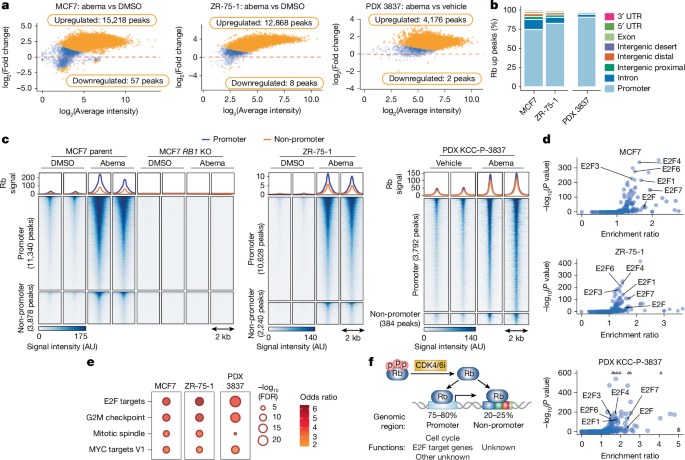
The retinoblastoma protein (Rb) is a tumour suppressor best known for repressing E2F transcription factors and halting cell cycle progression1. In hormone receptor-positive (HR+) breast cancer, CDK4/6 inhibitors activate Rb by preventing its phosphorylation, forming a key component of current endocrine therapy regimens2. How pharmacologically activated Rb remodels chromatin and influences transcription beyond cell cycle arrest remains poorly understood. Here we show that CDK4/6 inhibition induces redistribution of hypophosphorylated Rb to promoters and enhancers. Although Rb predictably binds to cell cycle gene promoters to repress transcription, at other sites, it unexpectedly promotes expression of oestrogen-responsive genes by integrating into oestrogen receptor (ER)-rich transcriptional hubs. CDK4/6 inhibition enhances ER target gene expression in breast cancer cells, patient-derived xenografts and clinical HR+ breast cancer samples in an Rb-dependent manner. This reprogramming is mediated in part by KDM5A, whose interaction with Rb contributes to gene regulation at these loci. Critically, components of this Rb-driven ER transcriptional program are pro-proliferative. In endocrine-sensitive tumours, this effect can be neutralized with anti-oestrogen therapy, explaining therapeutic synergy. In endocrine-resistant settings such as ESR1-mutant breast cancer, the program persists, limiting the therapeutic efficacy of CDK4/6 inhibition. These findings reframe Rb as a dual-function transcriptional regulator that, although enforcing cell cycle arrest, can also activate programs that counteract its tumour suppressor function.
The retinoblastoma protein is a tumour suppressor that prevents uncontrolled cell division1. It enforces G1 cell cycle arrest by binding to and antagonizing E2F transcription factors at gene promoters, thereby blocking expression of E2F target genes that are required for S-phase entry3,4,5,6. This repression is mediated by hypophosphorylated (‘active’) Rb7,8. During G1, cyclin-dependent kinases (CDKs)—specifically, CDK2, CDK4 and CDK6—phosphorylate Rb. Once hyperphosphorylated (‘inactive’), Rb releases E2F factors, driving irreversible S-phase commitment7.
Many cancer cells retain wild-type Rb expression, and the development of selective CDK inhibitors has positioned Rb as a critical therapeutic target. Selective CDK inhibitors enforce Rb hypophosphorylation, downregulate E2F target genes and induce G1 arrest2. Clinically, CDK4/6 inhibitors effectively suppress Rb phosphorylation and tumour proliferation in HR+ breast cancers, forming the cornerstone of first-line therapy in early and advanced disease9. CDK2 inhibitors are similarly promising for tumours driven by increased CDK2 activity10.
Beyond E2F repression, hypophosphorylated Rb probably has broader functions on chromatin. Studies from the pre-genomic era suggested that active Rb can interact with other transcription factors to modulate their activity11,12,13,14,15. Thus, pharmacologically activated Rb might not only halt cell division but also influence broader transcriptional programs that affect therapeutic outcomes. Despite widespread clinical use of CDK4/6 inhibitors, the downstream transcriptional consequences of sustained Rb activation in cancer remain poorly defined. Clarifying these effects could enhance CDK inhibitor use and elucidate resistance mechanisms.
Historically, mapping the genome-wide chromatin occupancy of Rb has proven difficult because of technical challenges associated with chromatin immunoprecipitation followed by sequencing (ChIP–seq), particularly the low signal-to-noise ratio typically observed8. Attempts to circumvent this problem have used exogenously expressed, tagged Rb16, an approach that might be insensitive to the marked cell cycle-dependent fluctuations in endogenous Rb abundance17 and prone to artefacts from tag-induced alterations in protein function,