// NATURE NEWS — SPAZIO & SCIENZA
In vivo genome-wide CRISPR screens of human T cells in solid tumours
Nature
(2026) Cite this article
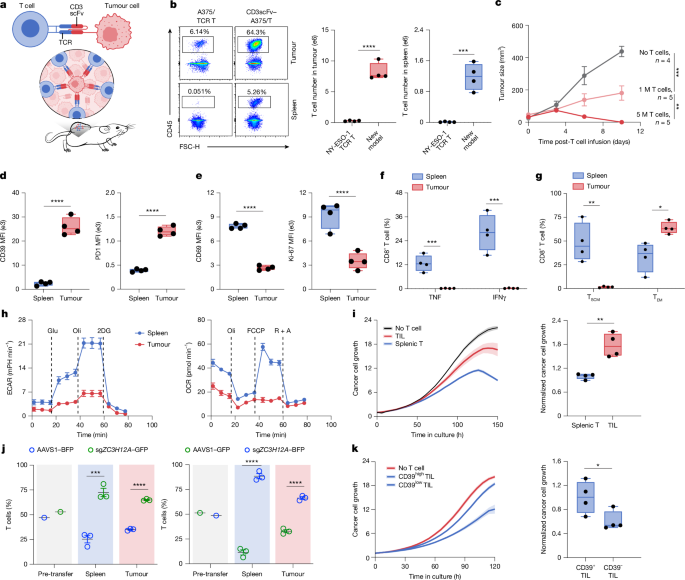
Large-scale CRISPR screening in human T cells holds significant promise for identifying genetic modifications that enhance cellular immunotherapy. Yet, many regulators of T cell performance in solid tumours are not revealed in vitro1,2. In vivo screening in tumour-bearing mice is more physiological but has been limited by low intratumoural T cell recovery. Here we developed an in vivo model that efficiently recovers human T cells from solid tumours, permitting genome-wide CRISPR screens with few mice. Tumour-infiltrating T cells from this model exhibit hallmarks of dysfunction compared with splenic T cells, creating an ideal screening context. We performed two genome-wide CRISPR knockout screens to identify regulators of intratumoural T cell abundance and effector function. The abundance screen revealed the P2RY8–Gα13 GPCR signalling axis as a negative regulator of T cell tumour infiltration. The effector function screen identified GNAS as a key driver of T cell dysfunction in tumours, whose product, Gαs, acts as a convergent node downstream of multiple GPCRs sensing distinct suppressive ligands. Knockout of GNAS rendered T cells resistant to multiple suppressive cues and significantly improved efficacy across diverse solid tumour models in chimeric antigen receptor (CAR) and T cell receptor (TCR) systems. Combinatorial knockout of P2RY8–GNAS further enhanced tumour control, demonstrating that complementary in vivo screens can identify orthogonal targets whose combined editing improves therapeutic potency. This flexible, scalable platform can be adapted for systematic discovery of genetic strategies to improve solid tumour T cell therapies.
This is a preview of subscription content, access via your institution
Access Nature and 54 other Nature Portfolio journals
Get Nature+, our best-value online-access subscription
Prices may be subject to local taxes which are calculated during checkout
All CRISPR screening data generated in this study are provided in Supplementary Tables 1, 2 and 5. The crRNA sequences used are listed in Supplementary Table 3. All RNA sequencing data are provided in Supplementary Table 6. The Gene Expression Omnibus accession number for RNA sequencing raw data is GSE330227. The human reference genome GRCh38.p14 was used for RNA sequencing alignment and analysis and is available (https://www.gencodegenes.org/human/release_45.html). Source data are available with this paper.
Carnevale, J. et al. RASA2 ablation in T cells boosts antigen sensitivity and long-term function. Nature 609, 174–182 (2022).
Article
ADS
CAS
PubMed
PubMed Central
Google Scholar
Freitas, K. A. et al. Enhanced T cell effector activity by targeting the Mediator kinase module. Science 378, eabn5647 (2022).