// SPACE.COM — SPAZIO & SCIENZA
Scientists find dead star that predicts our sun's future: 'Broken apart and returned to the galaxy'
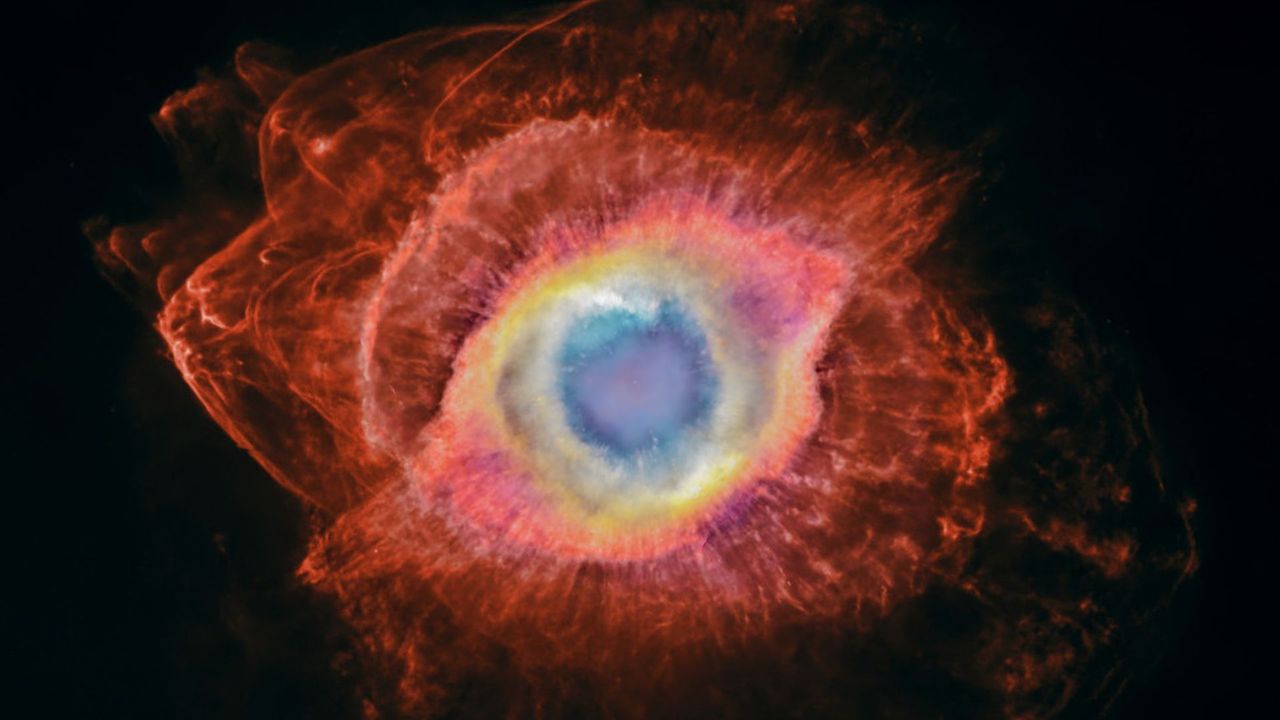
This will be the fate of our star in about five billion years' time.
When you purchase through links on our site, we may earn an affiliate commission. Here’s how it works.
Astronomers have watched a dead star, in the guise of the Helix Nebula, being recycled back into the interstellar gas from which it originally came, bringing the story of that star full circle.
Stars can last for millions, or even billions, of years, but they do not last forever. When a sun-like star reaches the end, it blossoms into a beautiful planetary nebula. The Helix Nebula, located 650 light-years away in the constellation of Aquarius, the Water Bearer, is one such example of a planetary nebula.
The Helix's central star has run out of hydrogen needed for nuclear fusion reactions in its core. This caused the core to begin to contract and raised the temperature in the star's outer layers, which ignited fusion reactions there instead. This had the effect of causing the star to bloat into a red giant. Then, eventually, the outer layers of that red giant detached and expanded into space to form the Helix Nebula. Meanwhile, the star's inert core contracted and became a white dwarf.
As the nebula expands, it gradually disperses into the interstellar medium (ISM), feeding the elements formed within the star back into interstellar gas clouds. These clouds will eventually produce the next generation of stars. However, astronomers had never actually seen the point at which a dead star's remains are absorbed into the ISM — until now.
"We are seeing material shed near the end of a star's life being broken apart and returned to the galaxy," said Yale University's Pieter van Dokkum, who led the study, in a statement. "That hand-off — from recognizable stellar debris to the diffuse gas between the stars — has been very difficult to observe."
Van Dokkum's team were not actually looking for this. Instead, they were conducting routine calibration of a new astronomical instrument called MOTHRA, the Modular Optical Telephoto Hyperspectral Robotic Array at the El Sauce Observatory in Chile. When complete, MOTHRA will be armed with 1,140 telephoto lenses that will scrutinize the night sky while looking for traces of faint gas in the Milky Way galaxy.
Astronomical instruments require calibration before use, and this is accomplished by targeting a familiar object in the sky and tuning the instruments to how that object should appear. The MOTHRA team used the Helix Nebula to calibrate the telephoto lenses that they currently have operational, and that was when they found something unexpected.
"We thought we were taking a calibration image of one of the best-known nebulas in the sky," Roberto Abraham of the University of Toronto said in the statement. "Instead, we found this extraordinary network of bow-shaped structures. It was immediately clear that the faint outer Helix was telling us a story that had largely been missed."