// NATURE NEWS — SPAZIO & SCIENZA
Five ways 3D printing is improving lab work
Neil Savage is a science and technology journalist in Massachusetts.
Search author on:
PubMed
Google Scholar
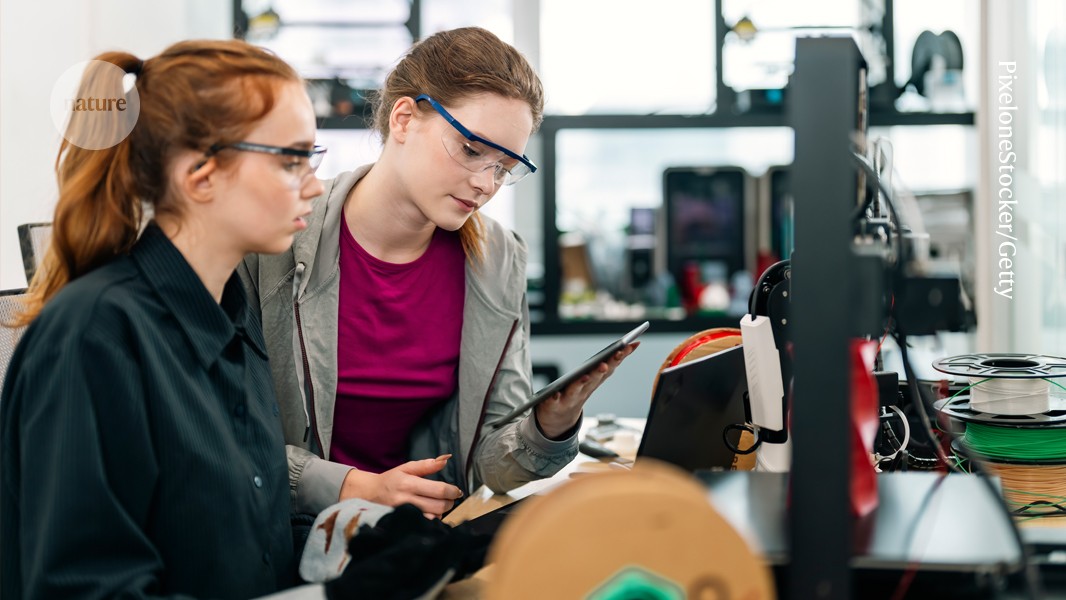
A 3D printer enables researchers to design and make laboratory equipment, often at a fraction of the cost of commercial items. Credit: PixeloneStocker/Getty
The day-to-day tasks of scientific research are rarely glamorous. As Trevor Rife worked towards his PhD in genetics, he had to extract DNA from freeze-dried tissue by grinding it in a 96-well plate. The process wasn’t difficult — it involved placing a ceramic bead into each well by hand, then capping the plate and shaking it so that the beads would crush the tissue and release the DNA. But picking up and placing beads manually was a chore. Automated bead dispensers existed, but his laboratory couldn’t afford them.
Now, as a plant scientist at Clemson University in South Carolina, Rife has bead dispensers aplenty — but he didn’t buy them. He builds them using a 3D printer. “It’s not like it’s groundbreaking hardware,” he concedes. But at roughly US$10 per bead dispenser, they save him so much time and money that they’re the favourite tools he has made with 3D printing.
Also known as additive manufacturing because of the way it builds objects layer on layer, 3D printing has been embraced by researchers for years — particularly during the COVID-19 pandemic (see ‘3D printing in the literature’). “Companies weren’t shipping materials to labs, but you could get the [printer] filament and 3D-print your own tube racks and things like that,” Rife says. Artificial-intelligence tools are also helping to optimize designs and monitor quality control.
Today, an entry-level 3D printer costs less than $2,500, with the cheapest selling for as little as $200. Bambu Lab in Shenzhen, China, offers several particularly popular options, and Rife has one in his lab — a Bambu X1C, which cost him about $1,200. He also has printers from other companies, such as a Prusa MINI that retails for about $550 and a Voron 0 that can be built from a kit for as little as a few hundred dollars, depending on the configuration.
Nature spoke to five researchers to learn how 3D printing is advancing their research.
Rife has designed several simple tools to help plant geneticists with their research, including a tray for counting seeds, squares to sort seeds by size and a hole-punch adapter for tubes used to collect tissue. His aim is to make plant research more accessible for researchers around the world. It’s so much easier, he explains, to e-mail someone a design file than it is to ship a piece of equipment.
World’s smallest 3D bioprinter could rebuild tissue during surgery