// NATURE NEWS — SPAZIO & SCIENZA
Pervasive phosphorylation by phage T7 kinase disarms bacterial defences
Nature
(2026) Cite this article
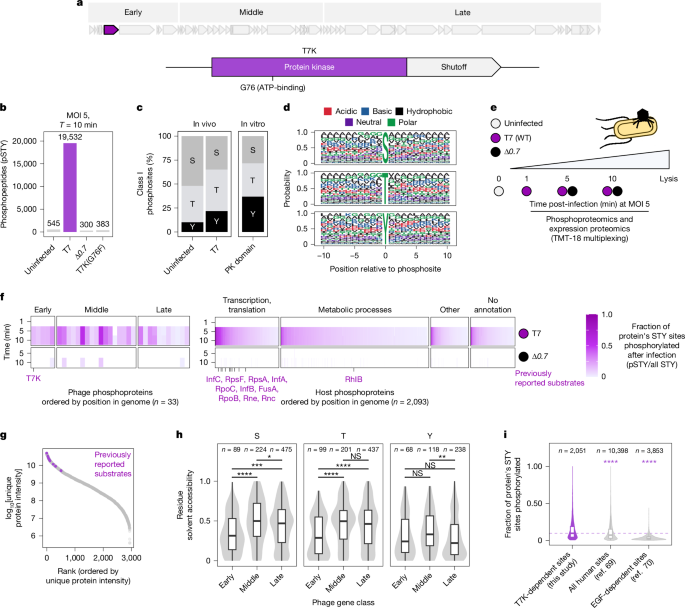
Bacteria and bacteriophages are in a constant arms race to develop defence and anti-defence systems, respectively. Currently known phage-encoded anti-defence systems are specific to the activity of the targeted bacterial defence system. Here we identify a mechanism by which the T7 bacteriophage broadly counteracts bacterial defences using protein phosphorylation. Its kinase (T7K), which has been reported to redirect the function of a few host proteins1,2,3,4,5, is actually a hyperpromiscuous dual-specificity kinase that phosphorylates nearly all host and phage proteins during infection. The scale of phosphorylation vastly exceeds known phosphosites in Escherichia coli, has no sequence motif specificity and results in a higher proteome-wide phosphorylation density than mammalian cells with around 500 kinases. Stoichiometry analysis of phosphorylation sites revealed strong bias in T7K activity towards nucleic-acid-binding substrates mediated by its C-terminal DNA-binding domain. This highly stoichiometric phosphorylation enables the deactivation of DNA-targeting or DNA-containing bacterial defence systems. We provide mechanistic insights into how T7K weakens DNA-containing Retron-Eco9 through specific phosphorylation events, with single phosphomimetic mutations in key sites of the toxin abolishing defence. Moreover, by screening a large collection of E. coli strains, we provide evidence of broad anti-defence abilities of T7K in nature, as counteracted strains contain diverse bacterial defence systems. T7K homologues are found almost exclusively in phages, with hyperpromiscuous kinase activity probably being enabled by a divergent DFG-like motif in the catalytic centre.
Bacteria and phages engage in an evolutionary arms race to overcome each other’s defences6. Our understanding of the bacterial immune repertoire and its mechanisms7 has increased considerably since 2018 from a few defence systems (mainly CRISPR and restriction-modification enzymes) to hundreds of new families6,8. Consistently, most of the phage-encoded anti-defence proteins are anti-CRISPR or anti-restriction-modification enzymes9,10. Only a few dozen anti-defence phage proteins against other systems have been recently identified. Most directly counteract the defence system11 by blocking its activity12 or sequestering its product13, while others repair the damage caused by the defence system14. In all cases, known phage-encoded anti-defence proteins counteract a single bacterial defence system, or more than one system when those use the same molecule15 or target the same host cellular machinery14.
Short reproduction cycles necessitate fast defence and anti-defence mechanisms16. Protein post-translational modifications, which are prominent in eukaryotic host–pathogen interfaces17, are emerging to be as important in phage–bacterial interactions. Acetylation deactivates host CRISPR defences18, ubiquitin-like modification interferes with phage assembly19 and ADP-ribosylation modulates host transcription20 and translation21. Protein phosphorylation is used in bacterial host defence22 and was recently implicated in phage-encoded anti-defence23.
Bacteriophage T7 infects E. coli and encodes a serine–threonine protein kinase known as gp0.7 or T7K (encoded by 0.7)2,24 that was identified in the 1970s24 (Fig. 1a). Known T7K substrates include the kinase itself25 and selected host proteins involved in transcription1,2,3, translation26,27 and nucleic acid processing1,27,28. The model is that T7K-mediated phosphorylation targets specific host proteins to hijack host cellular machineries for phage reproduction, shutting off or modulating host transcription2,3,4,5 and stabilizing phage mRNAs1. However, a clear understanding of the T7K function is lacking. The kinase is dispensable in standard growth conditions, with mild negative phenotypes in nutrient-poor medium and under heat stress29, and deactivates itself by p