// NATURE NEWS — SPAZIO & SCIENZA
Human organoids that mimic brain development grown for years in lab
Rachel Fieldhouse is a reporter for Nature in Sydney, Australia.
Search author on:
PubMed
Google Scholar
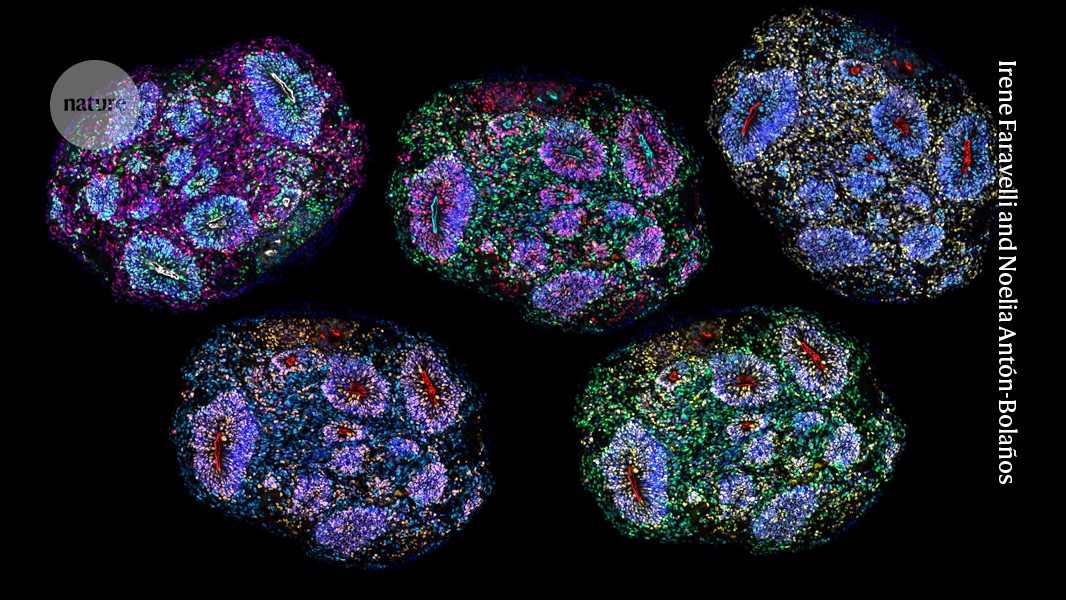
Brain organoids grown in the laboratory from human cells matured and developed traits similar to those seen in fetal and newborn brains.Credit: Irene Faravelli and Noelia Antón-Bolaños
Researchers have grown brain organoids that mirror the development of the human brain for more than five years1 — and are the longest-lived organs made in a laboratory, so far.
Until now, most brain organoids have been able to mimic only the early stages of the organ’s development and they usually start to die within months.
Growing organoids for so long is “an incredible feat”, says Maria Di Biase, a neuroscientist at the University of Melbourne in Australia. Watching them develop over time could help scientists to understand how diseases affect brain development.
Developmental neurobiologist Paola Arlotta, at Harvard University in Cambridge, Massachusetts, and her colleagues report today in Nature1 that organoids that are between 15 days and 2 months old undergo gene-expression changes similar to those that the fetal brain undergoes during the first trimester. The changes in organoids aged 3–6 months are comparable with those in the brain during the second trimester and, after 12 months of growth, the organoids show gene-expression patterns similar to the brain of a newborn baby. “Once we analysed the organoids, we realized that they didn’t just survive for five years, they continued to change, develop and mature over time,” says Arlotta. The team completed its analysis when the organoids reached five years old, but the mini organs continued to grow.
Cedric Bardy, a neurobiologist at Flinders University in Adelaide, Australia, says it is remarkable that the cells were ageing at the same pace as they would in a person’s brain over the five-year period.
Arlotta and her colleagues grew 34 organoids and collected data every 3–6 months for the first 18 months, and then each year until the organoids were five years old. They combined the data with those collected previously from organoids that grew for periods of 15 days to 6 months. The team found that, over time, the organoids showed cell-specifc signs of ageing, such as myelination — a process in which a protein membrane forms around certain brain cells — much like the human brain.
The researchers also discovered that cells in organoids retained a memory of their age and function. “We knew before this study that we can read a cell’s age from its molecular state,” says Di Biase. “But what’s exciting here is the evidence that the cell can also use that history to determine what it does next.”