// NATURE NEWS — SPAZIO & SCIENZA
The Antarctic ice sheet has gained mass — but probably not for long
Jonathan Wille is at the French National Centre for Scientific Research/Biogeosciences, University of Burgundy Europe, Dijon 21000, France.
Search author on:
PubMed
Google Scholar
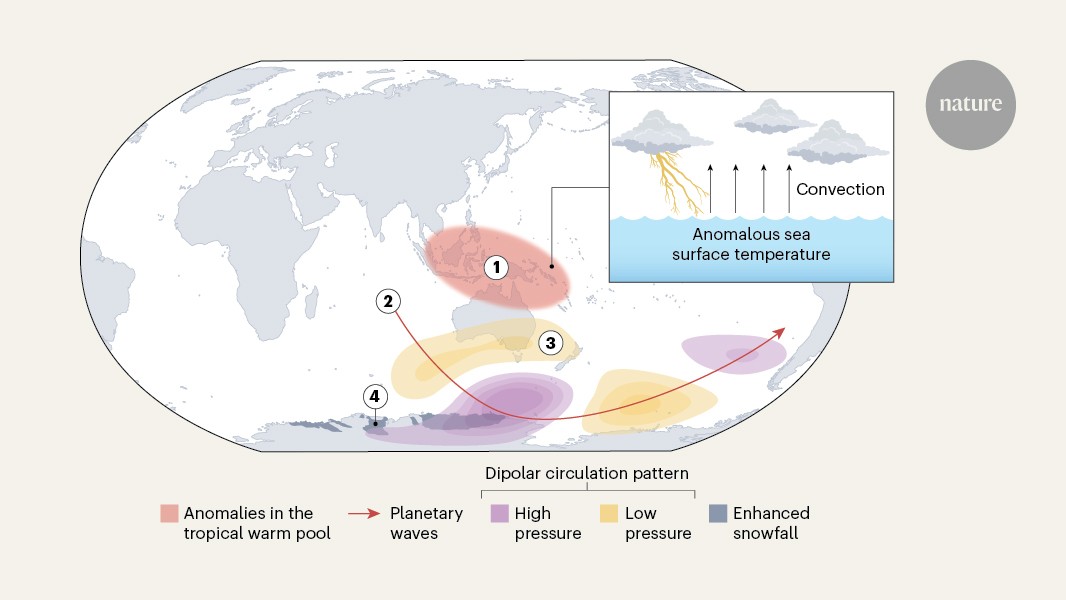
With record-breaking heatwaves, wildfires, a super El Niño and dwindling Arctic sea ice dominating the headlines, it might come as a surprise that loss of mass from the Antarctic ice sheet has essentially been on pause since about 2020. Writing in Nature, Wang et al.1 report that the cause is an atmospheric phenomenon that links warm seas in the Indian and Pacific Oceans with enhanced snowfall in Antarctica, counterbalancing ice mass lost to melting. Importantly, the authors found that the anomalous sea temperatures that are responsible for this trend occur roughly once every decade, so the Antarctic ice sheet looks set to return to losing mass in the next few years.
Access Nature and 54 other Nature Portfolio journals
Get Nature+, our best-value online-access subscription
Prices may be subject to local taxes which are calculated during checkout
Wang, Y. et al. Nature https://doi.org/10.1038/s41586-026-10912-x (2026).
Wang, Y., Wu, Q., Zhang, X. & Zhai, Z. Sci. Bull. 68, 3154–3157 (2023).
Kolbe, M. et al. Commun. Earth & Environ. 7, 255 (2026).
Wille, J. D. et al. Nature Rev. Earth Environ. 6, 178–192 (2025).