// SPACE.COM — SPAZIO & SCIENZA
My favorite thing in the night sky appears on Aug. 28 — and it proves Earth is a sphere
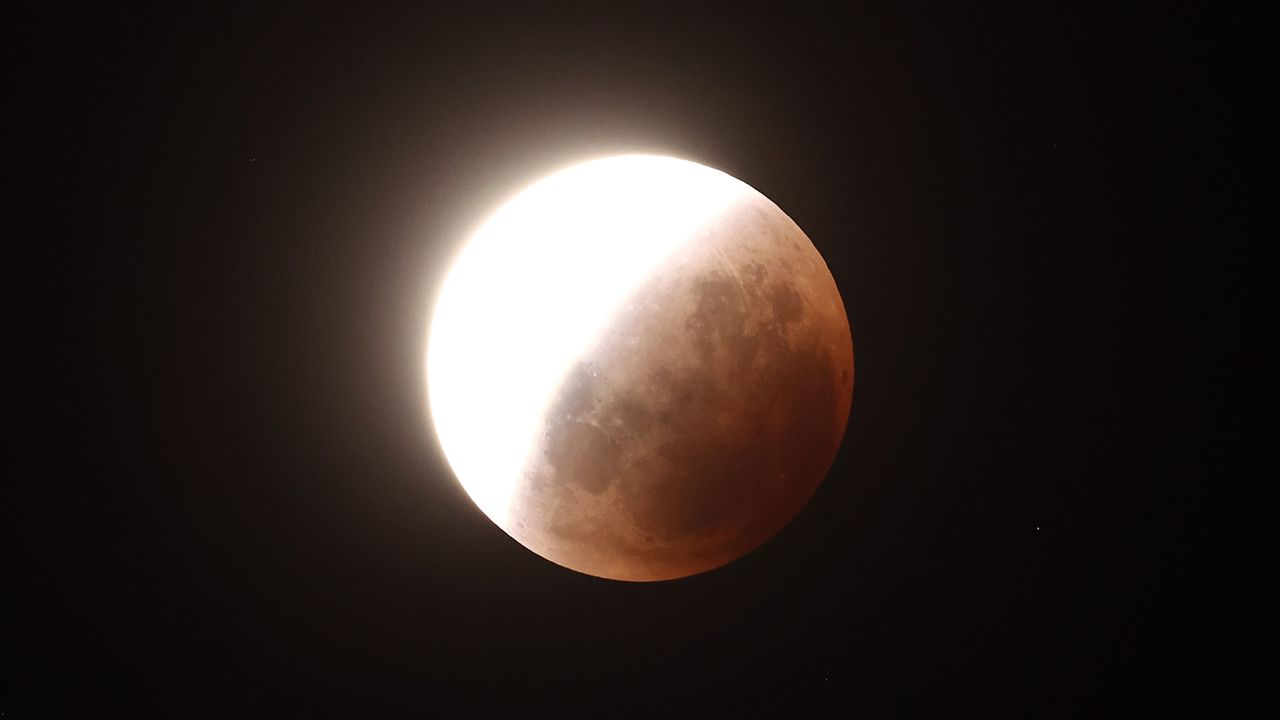
We'll soon get a chance to see a giant curved shadow in space move slowly across the moon during a very deep partial lunar eclipse. There are few more awesome or enlightening sights.
When you purchase through links on our site, we may earn an affiliate commission. Here’s how it works.
What's your favorite thing in the night sky? Maybe it's the Pleiades, that sparkling open cluster that dominates winter in the Northern Hemisphere. Perhaps it's a sight of the Milky Way arching across the summer sky. Or could it be Saturn, a close-up sight of which has many people reaching for their wallets to buy a bigger telescope.
My favorite sight? It's us or, rather, our shadow. It's something that's only observable during a partial lunar eclipse — and there's one coming up very soon. Overnight on Aug. 27-28, an unusually deep partial lunar eclipse will be visible across Europe and North America, during which I will be watching Earth's shadow do something spectacular for precisely 3 hours, 18 minutes and 5 seconds.
A lunar eclipse happens when the sun, Earth and a full moon — in this case, August's Sturgeon Moon — line up closely enough for the moon to pass through Earth's shadow, a vast cone of darkness stretching away into space. Because the sun is a disk rather than a point of light, Earth's shadow tapers as it travels, narrowing like the beam of a flashlight in reverse. It creates two distinct shadows:
Those shadows create, in turn, three phases — penumbral, partial and total — as the moon passes through Earth's shadow. What we'll get on Aug. 27-28 is a penumbral phase, followed by a partial phase, followed once again by a penumbral phase. No totality, no drama? Not quite. During a partial lunar eclipse, part of the moon enters the umbra, allowing us to see the curved edge of our planet's shadow projected onto the lunar surface. It is one of astronomy's most direct visual proofs that Earth is a sphere.
During the Aug. 27-28 event, just over 96% of the moon will pass into the umbra, which is why it will look almost, but not quite, total. It may even make the moon look pinkish close to that maximum eclipse, because the umbra is not completely black. Sunlight bent and filtered through Earth's atmosphere leaks into the shadow, carrying the red-orange glow of every sunrise and sunset around the world.
Total lunar eclipses get the "blood moon" nickname, leaving partial lunar eclipses sounding like leftovers. But a deep partial eclipse can be stranger because one bright sliver remains outside the darkest part of Earth's shadow while the rest of the moon turns dim and rusty. You also get more of an impression of the moon moving slowly through a circular shadow in space.
North and South America get the best view. In North America, maximum eclipse occurs late on Aug. 27 in the west and around or after midnight on Aug. 28 farther east. Europe sees the eclipse before dawn on Aug. 28, with the moon low and setting during the later stages in many places. A clear western horizon will matter there.
Knowing the schedule is key. Punch in your location to Time Date, and you'll get timings for the eclipse's phases, with the partial phase the one to watch. For example, the partial phase in New York will begin at 10:33 p.m. EDT on Aug. 27, peak at 96% at 00:12 a.m. EDT on Aug. 28, and end at 01:51 a.m. EDT. In Los Angeles, it will be 7:33 p.m. PDT, 9:12 p.m. PDT and 10:51 p.m. PDT on Aug. 27. From London, it will be 3:33 a.m. BST, 5:12 a.m. BST and end as the moon sets at 6:15 a.m. BST on Aug. 28.